JUMP TO PRODUCT LIST
Our difference
Investor focused. Purposeful design and evolution. Time-tested performance.*
No.
1
in TDF assets under management**
15
+ million
investors entrusting us with more than $1 trillion in TDF assets***
38
%
of the TDF industry, more than any other TDF provider***
Target Retirement Series specifications
| Vanguard Target Retirement Series | |
|---|---|
| Corporate ownership structure | Vanguard is investor owned† |
| Inception date (oldest share class) | 10/27/2003 |
| Firm TDF market share AUM†† | 38% |
| Strategy | Index based |
| Glide path | Through retirement |
Our approach to glide-path design
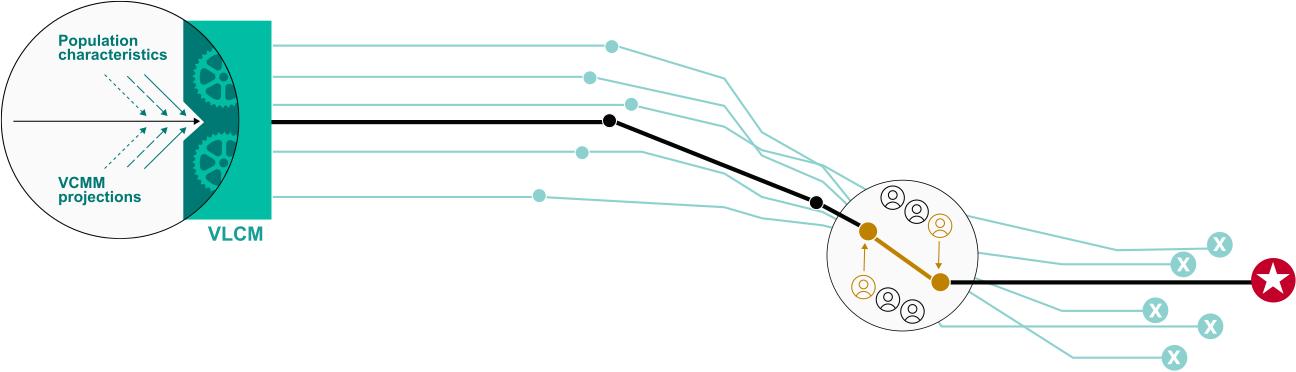

Comprehensive inputs
We combine participant population characteristics with the Vanguard Capital Markets Model® (VCMM) asset-class forecasts—comprised of distributions of expected returns, volatilities, and correlations—to evaluate potential downside risks, various risk–return trade-offs, and the diversification benefits of various asset classes.

Constantly evaluated
Due diligence is done through constant analysis of the existing glide path against thousands of simulated glide paths using our Vanguard Life-Cycle Investing Model (VLCM).

Designed for the real world
Practical considerations and observed participant behavior are taken into account to meet the needs of real-world TDF investors.

Helping improve investor outcomes
We focus on meeting the long-term goals of wealth accumulation, balancing portfolio volatility, and maximizing drawdown ability to ensure a high likelihood of meeting the retirement income sufficiency needs of investors.

Comprehensive inputs
Participant population characteristics
Our framework incorporates a long list of investor characteristic data leveraged from How America Saves, Vanguard’s annual comprehensive look at Americans’ retirement saving habits. Characteristics include participant demographics, risk tolerance profile, retirement funding needs, saving rates, expected retirement age, and guaranteed income sources such as Social Security or defined benefit pensions.
Vanguard Capital Markets Model® (VCMM)
The VCMM is a proprietary financial simulation tool developed and maintained by Vanguard’s primary investment research team. The VCMM projections are based on a statistical analysis of historical data. The model forecasts distributions of future returns for a wide array of broad asset classes.

Constantly evaluated
Most investors have multiple goals throughout their lifetime, and the Vanguard Life-Cycle Investing Model (VLCM) factors in each complex, interconnected decision about saving, spending, and asset allocation.
While made up of multiple inputs, our framework focuses on investor retirement outcomes and aims to strike a balance between two primary objectives of investment portfolios: growth to provide wealth to meet retirement spending needs and stability to provide comfort in volatile markets, particularly for those near or in retirement. Our Strategic Asset Allocation Committee, composed of global investment leaders from across the firm, meets regularly to review our investment methodology, debate investment strategies, and coordinate any changes with Vanguard’s Advice Policy Committee, thereby ensuring a consistent approach to meeting the retirement needs of TDF investors.
Glide path
Our thoughtful approach allows our TDFs to help support income throughout a participant’s retirement.
Portfolio construction
Our asset management experts have carefully considered the composition of our TDFs.

Designed for the real world
Leveraging the VLCM, we use the glide-path results representing different lifestyle personas in retirement to evaluate its sufficiency in supporting the income needs associated with each persona.
We examine three distinct retirement goals:
- Maintain lifestyle.
- Enhance lifestyle.
- Leave a legacy.
In designing a glide path that supports investors’ needs and aligning it with their retirement age, risk tolerance, and other characteristics, our glide-path approach is most aligned with helping to ensure that clients have the savings necessary to maintain their lifestyle through retirement. Our glide-path design incorporates elements of that analysis so we have a better picture of what an actual average investor looks like and how we can tailor the design to that investor.
Stress-testing our assumptions
Our research team constantly tests the model to make sure our assumptions reflect real-world conditions (be they robust market returns, inflation, or volatility), include a range of possible asset classes, and reflect the needs and wants of modern-day retirement savers. We have a responsibility to investors who rely on this glide path to help carry them through retirement. We take that very seriously.
In general, our Target Retirement Fund investors:
- Have a moderately conservative risk tolerance.
- Save at the average rate for their age cohort.
- Want to retire at age 65.
- Expect 75% to 80% of their ending salary annually in retirement.

Helping improve investor outcomes
Vanguard Target Retirement Funds and Trusts can help bring financial well-being for participants and fiduciary well-being for you. Our approach to building TDFs ensures that the wide range of investors who count on TDFs to secure their retirement have an investment solution well positioned to meet their needs.
In evaluating the benefits of TDFs in retirement plans, we focus on meeting long-term goals for retirement income sufficiency:
- Wealth accumulation—optimizing outcomes through our time-tested investment techniques, helping give participants a better chance for lasting income through retirement.
- Portfolio volatility—appropriately balancing risk and return, which offers retirement confidence for participants.
- Maximum drawdown—weathering tough times during notable market downturns to help preserve retirement savings.
Depth that drives decisions

Target-date funds continue to shape retirement investing. Now in its 25th year, How America Saves highlights the growing role of professionally managed allocations and plan design trends that help participants stay on track. Explore the industry’s deepest research for insights that support better decisions—and outcomes.

Looking to fill a mandate?
Already a client? Contact your representative today.
*Vanguard and Morningstar, Inc., as of December 31, 2025. Our Target Retirement Funds with a 10-year track record or longer (2060 and earlier vintages), on average, ranked in the 75th percentile among peer groups for 10-year returns through 2025. Vanguard Target Retirement Income Fund ranked 43rd out of 103 peers; 2020 Fund, 34th out of 74; 2025 Fund, 23rd out of 103; 2030 Fund, 28th out of 138; 2035 Fund, 36th out of 140; 2040 Fund, 41st out of 138; 2045 Fund, 41st out of 140; 2050 Fund, 23rd out of 138; 2055 Fund, 28th out of 139; and 2060 Fund, 27th out of 85. Only competing funds with a 10-year history were included. Results will vary in other time periods. Note that the competitive performance data shown represent past performance, which is not a guarantee of future results, and that all investments are subject to risks. Investment returns and principal value will fluctuate, so investors' shares, when sold, may be worth more or less than their original cost. Current performance may be lower or higher than the performance data cited. For the most recent performance, visit our website at vanguard.com/performance.
**Vanguard and Morningstar's Target-Date Strategy Landscape: 2025.
***DC assets are based on AUM in both Vanguard-administered plans and those administered by others. Other figures are based on AUM market share of the TDF industry. Sources: Vanguard and Morningstar, Inc., as of December 31, 2025.
†Vanguard is owned by its funds, which are owned by Vanguard's fund shareholders.
††Vanguard and Morningstar, Inc., as of December 31, 2025.
Disclosures
For more information about Vanguard funds, visit vanguard.com to obtain a prospectus or, if available, a summary prospectus. Investment objectives, risks, charges, expenses, and other important information about a fund are contained in the prospectus; read and consider it carefully before investing.
All investing is subject to risk, including the possible loss of the money you invest. Diversification does not ensure a profit or protect against a loss.
Investments in Target Retirement Trusts and Funds are subject to the risks of their underlying funds. The year in the trust or fund name refers to the approximate year (the target date) when an investor in the trust or fund would retire and leave the workforce. The trust or fund will gradually shift its emphasis from more aggressive investments to more conservative ones based on its target date. The Income Trust/Fund and the Income and Growth Trust have fixed investment allocations and are designed for investors who are already retired. An investment in a Target Retirement Trust or Fund is not guaranteed at any time, including on or after the target date.
Vanguard is responsible only for selecting the underlying funds and periodically rebalancing the holdings of target-date investments. The asset allocations Vanguard has selected for the Target Retirement Funds are based on our investment experience and are geared to the average investor. Regularly check the asset mix of the option you choose to ensure it is appropriate for your current situation.
Vanguard Target Retirement Trusts are not mutual funds. They are collective trusts available only to tax-qualified plans and their eligible participants. Investment objectives, risks, charges, expenses, and other important information should be considered carefully before investing. The collective trust mandates are managed by Vanguard Fiduciary Trust Company, a wholly owned subsidiary of The Vanguard Group, Inc.