Launched in 1975, The Vanguard Group, Inc. (VGI), Malvern, Pennsylvania, is among the world’s largest equity and fixed income managers. VGI’s wholly-owned subsidiary, Vanguard Fiduciary Trust Company (VFTC), manages Vanguard’s collective investment trust mandates. The group has advised Vanguard Total Stock Market Index Trust II since 2026.
Overview
Vanguard Total Stock Market Index Trust II seeks to track the performance of a benchmark index that measures the investment return of the overall stock market.
Investment approach
- Seeks to track the performance of the Morningstar US Total Market Index.
- Large-, mid-, and small-cap equity diversified across growth and value styles.
- Passively managed, using index sampling.
- Fund remains fully invested.
- Low expenses minimize net tracking error.
Benchmark
- The Morningstar US Total Market Index represents approximately 100% of investable companies in the U.S. equity market.
- The index is designed to accurately represent the U.S. equity market and deliver low turnover.

Investment Tools
Access fund data to perform in-depth analysis
Fund facts
| YTD Returns (NAV) | — |
|---|---|
| — | |
| Inception date | 10/08/2026 |
| $489.9B | |
| $489.9B | |
| Fund number | V121 |
| CUSIP | 92214F105 |
| Designation | Domestic Large Blend |
| Benchmark | Morningstar U.S. Total Market Index |
Fees & minimum
| None | |
| None | |
| Minimum investment |
Performance
Total returns
RECENT RETURNS
AVERAGE ANNUAL
| Month-end | YTD | 1 YEAR | 3 YEAR | 5 YEAR | 10 YEAR | ||
|---|---|---|---|---|---|---|---|
V121 (NAV) | — | — | — | — | — | — | — |
| — | — | — | — | — | — | — | |
| — | — | — | — | — | — | — |
Collective Trust returns are computed taking into account all trading costs, but do not reflect the deduction of other costs or fees, including investment advisory fees. The collective trusts are managed by Vanguard Fiduciary Trust Company, a subsidiary of The Vanguard Group, Inc.
*Consists of large-, mid-, small-, and micro-cap stocks representing nearly 100% of the investable U.S. stock market.
| YEAR | 1ST QUARTER | 2ND QUARTER | 3RD QUARTER | 4TH QUARTER |
|---|
| YEAR |
|---|
| AS OF | 1 MONTH | 3 MONTH | YTD AS OF | YTD AS OF | 1 YEAR | 3 YEAR | 5 YEAR | 10 YEAR | |
|---|---|---|---|---|---|---|---|---|---|
V121 (NAV) | |||||||||
The performance data shown represents past performance, which is not a guarantee of future results. Investment returns and principal value will fluctuate, so that investors' shares, when sold, may be worth more or less than their original cost. Current performance may be lower or higher than the performance data cited.
Performance data for periods of less than one year does not reflect the deduction of purchase and redemption fees. Maintenance, low balance, and service fees may be assessed by some funds. None of these fees are reflected in the performance figures. If these fees were included, the performance would be lower. All other performance data are adjusted for purchase and redemption fees, where applicable.
The performance of an index is not an exact representation of any particular investment, as you cannot invest directly in an index. Benchmark comparative indexes represent unmanaged or average returns on various financial assets, which can be compared with funds' total returns for the purpose of measuring relative performance.
Price & Distributions
Closing price
Closing price as of
NAV
NAV change
52-week high
52-week low
52-week difference
Portfolio
Market capitalization
as of 10/31/2026| MARKET SIZE | V121 | +/- WEIGHT | |
|---|---|---|---|
| Large | — | — | — |
| Medium/Large | — | — | — |
| Medium | — | — | — |
| Medium/Small | — | — | — |
| Small | — | — | — |
More information about market capitalization
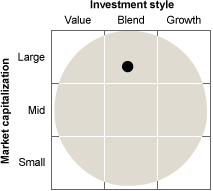
Style box
Stocks
Index portfolio of large-, mid-, and small-capitalization stocks diversified across investment styles.

Central Tendency

Expected range
Fundamentals
| FUNDAMENTAL | V121 | |
|---|---|---|
| Number of stocks | — | — |
| Avg market cap | — | — |
| — | — | |
| Earnings growth rate | — | — |
| P/E ratio | — | — |
| P/B ratio | — | — |
| — | — | |
| Return on equity | — | — |
| Foreign holdings | — | — |
Holdings details
As of date
* Percentages may not add up to 100%. SEC regulations allow us to withhold a certain amount of holdings as proprietary information.
Weighted exposures
as ofThe composition of the portfolio's primary asset class. (i.e., for a bond fund, weighted exposures show the composition of the fund's bond allocation and will exclude other asset classes such as the short-term reserves).
Risk and volatility
as of
As with any investment, an investment in the trust portfolio could lose money over any time period. The fund’s share price and total return may fluctuate, potentially within a wide range. The principal risks of investing in the fund are summarized below. Each of the following risks could affect the fund’s performance:
- General Market Risk. The markets in which the fund invests can be affected by a variety of factors. These factors, which can be real or perceived, may include economic, market, political, and regulatory conditions and developments as well as local, regional, or global events such as wars, military conflicts, natural disasters, and public health issues. In addition, investor sentiment and expectations regarding these factors can also impact the markets. Different parts of the market, including different industries and sectors as well as different types of securities, may react differently to factors that affect the market. These factors can contribute to market uncertainty, market volatility, and fluctuations in the value of the fund’s investments, thereby resulting in potential losses to the fund over short or long periods.
- Investing in Equity Markets. The fund invests in the equity markets. Equity markets have historically been cyclical, having periods of time when stock values rise and fall. Market volatility can lead to significant fluctuations in stock values, resulting in potential losses to the fund.
- Market Capitalization (Market Cap). Companies are generally classified into three types of market cap depending on their size: small-, mid-, and large-cap. Companies can be further classified into micro- or mega-cap. Different factors can affect each market cap uniquely, and historically small-and mid-cap stocks have typically been more volatile due to the effects of changing economic conditions. Large companies may not reach the same levels of growth or performance as smaller companies, and they may be slower to react to competitive challenges. The performance of funds that invest in a subset of market caps could diverge from the performance of a fund that is focused on a broader representation of the stock market.
- Index Investing. The fund is subject to risks associated with index investing. Because the fund generally seeks to track the performance of the target index regardless of how the target index is performing, the fund’s performance may be lower than it would be if it were actively managed. Additionally, because the fund does not hold all of the securities included in the target index, it is subject to the risk that the representative sample of securities selected by the advisor will, in the aggregate, vary from the investment profile of the full target index. The performance of the fund’s investments, in the aggregate, may not match the investment performance of the target index. This risk, known as tracking error risk, may be heightened during times of increased market volatility or under other unusual market conditions. The fund also could be negatively impacted by changes to the target index made by the index provider or by errors made by the index provider. Any gains, losses, or costs associated with or resulting from an error made by the index provider will generally be borne by the fund and, as a result, the fund’s shareholders.
- Nondiversification. By tracking its broad-based target index, the fund could become nondiversified, as defined under the Investment Company Act of 1940, due to events such as an index rebalance or market movement. The performance of nondiversified funds may be negatively impacted by relatively few securities or even a single security and their shares may experience significant fluctuations in value.
- Concentration Risk. Except as may be necessary to approximate the composition of its target index, the fund will not concentrate its investments in the securities of issuers whose principal business activities are in the same industry or group of industries. If the target index becomes concentrated and the fund needs to concentrate in the same industry or group of industries, its performance could be negatively impacted by the industry or industries in which it is concentrated.
- Information Technology Sector. As of the fund’s most recent fiscal year end, stocks of companies within the information technology sector made up a significant portion of the target index. As a result, the performance of the target index, and therefore the performance of the fund, may be impacted by the general condition of the information technology sector.
Management
Vanguard Total Stock Market Index Trust II seeks to track the investment performance of the Morningstar US Total Market Index, which represents approximately 100% of the investable U.S. stock market and includes large-, mid-, small-, and micro-cap stocks regularly traded on the New York Stock Exchange and Nasdaq. The trust invests by sampling the index, meaning that it holds a broadly diversified collection of securities that, in the aggregate, approximates the full index in terms of key characteristics. The Global Equity Index Management team applies disciplined portfolio construction and efficient trading techniques designed to help minimize tracking error and maintain close alignment with benchmark characteristics. The team uses proprietary software to implement trading decisions that accommodate cash flow and preserve index characteristics. Vanguard’s refined indexing process, combined with low management fees and efficient trading, has provided tight tracking net of expenses.