Launched in 1975, The Vanguard Group, Inc., Malvern, Pennsylvania, is among the world’s largest equity and fixed income managers. Vanguard’s wholly owned subsidiary, Vanguard Capital Management, an independent investment advisor designed to enhance fund oversight and operational efficiency, is focused on equity, fixed income, and multi-asset strategies. Equity index funds are managed by Global Equity Index Management, covering U.S. and international markets. Global Equity Index Management has developed sophisticated portfolio construction methodologies and efficient trading strategies that seek to deliver returns that are highly correlated with target portfolio benchmarks. The group has advised Vanguard Emerging Markets ex-China ETF since 2025.
Overview
Vanguard Emerging Markets ex-China ETF seeks to track the performance of a benchmark index that measures the investment return of stocks issued by companies located in emerging market countries, excluding China.
Investment approach
- Seeks to track the performance of the FTSE Emerging ex China Index.
- Passively managed, using index sampling.
- The fund invests substantially all of its assets in the stocks included in the index.
With respect to 75% of its total assets, the fund may not: (1) purchase more than 10% of the outstanding voting securities of any one issuer or (2) purchase securities of any issuer if, as a result, more than 5% of the fund’s total assets would be invested in that issuer’s securities; except as may be necessary to approximate the composition of its target index. This limitation does not apply to obligations of the U.S. government or its agencies or instrumentalities.

Investment Tools
Access fund data to perform in-depth analysis
Fund facts
as of 12/19/2025 | 0.07% |
|---|---|
| YTD Returns (MP) as of 11/17/2026 | 10.88% |
| YTD Returns (NAV) as of 11/17/2026 | 11.38% |
| — | |
as of 10/31/2026 | 2.45% |
| Inception date | 09/30/2025 |
| $267.5M | |
| $267.5M | |
| Fund number | V051 |
| CUSIP | 921910683 |
| Designation | Diversified Emerging Markets |
| Benchmark | FTSE Emerging ex China Index |
Fees & minimum
| None | |
| None | |
| Minimum investment |
Trading
| VEXC.IV | |
| Outstanding shares as of 10/31/2026 | 3,000,000 |
| ETF exchange | New York Stock Exchange Arca |
Performance
Total returns
0.07%
RECENT RETURNS
AVERAGE ANNUAL
| Month-end | YTD | 1 YEAR | 3 YEAR | 5 YEAR | 10 YEAR | ||
|---|---|---|---|---|---|---|---|
| ***VEXC (Market price) | — | — | — | — | — | — | — |
VEXC (NAV) | — | — | — | — | — | — | — |
| — | — | — | — | — | — | — | |
| — | — | — | — | — | — | — | |
| — | — | — | — | — | — | — |
Note: Except the most recent quarter, the expense ratios presented are the funds' actual operating expenses and they exclude any acquired fees and expenses, which result from the funds' holding in business development companies (BDCs). BDCs expenses are not direct costs paid by fund shareholders and are not used to calculate the funds' net asset value.
*The FTSE Emerging ex China Index is a market-capitalization weighted index that is made up of common stocks of large- and mid-cap companies located in emerging markets around the world, excluding China.
NAVMarket price
| YEAR | 1ST QUARTER | 2ND QUARTER | 3RD QUARTER | 4TH QUARTER |
|---|
| YEAR |
|---|
| AS OF | 1 MONTH | 3 MONTH | YTD AS OF | YTD AS OF | 1 YEAR | 3 YEAR | 5 YEAR | 10 YEAR | |
|---|---|---|---|---|---|---|---|---|---|
| VEXC ( Market price ) | |||||||||
VEXC (NAV) | |||||||||
The performance data shown represents past performance, which is not a guarantee of future results. Investment returns and principal value will fluctuate, so that investors' shares, when sold, may be worth more or less than their original cost. Current performance may be lower or higher than the performance data cited.
Performance data for periods of less than one year does not reflect the deduction of purchase and redemption fees. Maintenance, low balance, and service fees may be assessed by some funds. None of these fees are reflected in the performance figures. If these fees were included, the performance would be lower. All other performance data are adjusted for purchase and redemption fees, where applicable.
The performance of an index is not an exact representation of any particular investment, as you cannot invest directly in an index. Benchmark comparative indexes represent unmanaged or average returns on various financial assets, which can be compared with funds' total returns for the purpose of measuring relative performance.
Price & Distributions
Current price
Current market price as of ETMarket Price
Size
5x5
Daily change
$0.76 (0.65%)
Tick
UP
Open
$160.35
Volume
99,885
High
$162.07
Bid/ask spread
$0.06 (0.04%)
Low
$160.17
Closing price
Closing price as of
52-week low
Market price change
52-week difference
NAV
Premium/discount
NAV change
25-day avg volume
30-DAY MEDIAN BID/ASK SPREAD
50-day avg volume
52-week high
Premium/Discount chart
Realized/Unrealized gains
as of
Realized gain
Distribution schedule
Quarterly
Unrealized gains of NAV
Fiscal year-end date
Distribution
Use this table to view or export up to ten years of distributions for this fund.
No distribution records available.
Portfolio
Market capitalization
as of 10/31/2026| MARKET SIZE | VEXC | +/- WEIGHT | |
|---|---|---|---|
| Large | — | — | — |
| Medium/Large | — | — | — |
| Medium | — | — | — |
| Medium/Small | — | — | — |
| Small | — | — | — |
More information about market capitalization
Style box
Stocks
Index portfolio of emerging market equities diversified across investment styles.
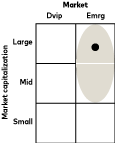

Central Tendency

Expected range
Fundamentals
| FUNDAMENTAL | VEXC | |
|---|---|---|
| Number of stocks | — | — |
| Avg market cap | — | — |
| — | — | |
| % Emerging | — | — |
| % Developed | — | — |
| Earnings growth rate | — | — |
| % of ADR/GDR (as of ) | — | — |
| P/E ratio | — | — |
| P/B ratio | — | — |
| — | — | |
| Return on equity | — | — |
| Foreign holdings | — | — |
Holdings details
as of 11/17/2026
Sector categories are based on the Industry Classification Benchmark system (“ICB”), except for the “Other” category (if applicable), which includes securities that have not been provided an ICB classification as of the effective reporting period.
* There may be deviations when applying fair value and other considerations.
Weighted exposures
as ofSector categories are based on the Industry Classification Benchmark system (“ICB”), except for the “Other” category (if applicable), which includes securities that have not been provided an ICB classification as of the effective reporting period.
The composition of the portfolio's primary asset class. (i.e., for a bond fund, weighted exposures show the composition of the fund's bond allocation and will exclude other asset classes such as the short-term reserves).
Risk and volatility
as of
As with any investment, an investment in the fund could lose money over any time period. The fund’s share price and total return may fluctuate, potentially within a wide range. The principal risks of investing in the fund are summarized below. Each of the following risks could affect the fund’s performance:
- General Market Risk. The markets in which the fund invests can be affected by a variety of factors. These factors, which can be real or perceived, may include economic, market, political, and regulatory conditions and developments as well as local, regional, or global events such as wars, military conflicts, natural disasters, and public health issues. In addition, investor sentiment and expectations regarding these factors can also impact the markets. Different parts of the market, including different industries and sectors as well as different types of securities, may react differently to factors that affect the market. These factors can contribute to market uncertainty, market volatility, and fluctuations in the value of the fund’s investments, thereby resulting in potential losses to the fund over short or long periods.
- Investing in Foreign Markets. Foreign markets can perform differently than U.S. markets. World events could adversely affect the value and/or liquidity of securities of foreign companies or foreign issuers, potentially in ways that differ from impacts to U.S. companies or issuers. Further, global economies and financial markets are becoming increasingly interconnected, which increases the possibility that conditions in one country or region could adversely impact a different country or region. In addition, the rights and remedies associated with investments in a fund that invests in foreign securities may be different than a fund that invests in domestic securities. To the extent that the fund invests a large portion of its assets in securities of issuers located primarily in one country or region, the fund’s performance may be hurt disproportionately by the poor performance of its investments in such country or region.
- Investing in Emerging Markets. Investments in emerging markets are subject to higher degrees of risk and volatility than investments in developed markets. Compared with developed markets, emerging markets can have greater custodial and operational risks; less developed legal, tax, regulatory, financial reporting, accounting, and recordkeeping systems; and greater political, social, and economic instability than developed markets. In addition, emerging markets generally have less efficient trading markets with lower overall liquidity and more volatile currency exchange rates. Each of these risks can cause losses to the fund’s investments and/or impact the fund’s performance.
- Currency Risk. The fund is subject to the risk that foreign currency will perform differently than U.S. dollars and increase the potential loss to the fund. Currency exchange rates may be volatile, move rapidly, and change as a result of changes in interest rates, inflation rates, government surpluses or deficits, and monetary policy or currency controls imposed by local governments or supranational entities such as the International Monetary fund. Changes in currency exchange rates can affect the value of the fund’s holdings.
- Ex-China Investing. The index provider excludes certain stocks from the target index based on its own assessment of whether the issuer is a Chinese company. The index provider relies on a proprietary method to determine whether an issuer meets its specified criteria to be defined as a Chinese company; however, the index provider’s criteria may differ from other assessments of what it means for an issuer to be a Chinese company. Additionally, the target index is a market-capitalization weighted index, and its exclusion of Chinese companies causes the fund to invest more heavily in stocks from other emerging markets, thereby increasing the fund’s weighting in fewer markets. As a result, the fund’s investment performance may be impacted by the economic, political, and social conditions in those markets. Lastly, though the target index’s methodology does not include Chinese companies, the target index, and therefore the fund, may have significant exposure to countries that could be materially impacted politically, economically, or otherwise by China. For example, the fund has significant investments in Taiwan that are subject to legal, regulatory, political, currency and economic risks which may be heightened by Taiwan’s geographic proximity to and ongoing geopolitical tensions with China.
- Investing in Equity Markets. The fund invests in the equity markets. Equity markets have historically been cyclical, having periods of time when stock values rise and fall. Market volatility can lead to significant fluctuations in stock values, resulting in potential losses to the fund.
- Market Capitalization (Market Cap). Companies are generally classified into three types of market cap depending on their size: small-, mid-, and large-cap. Companies can be further classified into micro- or mega-cap. Different factors can affect each market cap uniquely, and historically small-and mid-cap stocks have typically been more volatile due to the effects of changing economic conditions. Large companies may not reach the same levels of growth or performance as smaller companies, and they may be slower to react to competitive challenges. The performance of funds that invest in a subset of market caps could diverge from the performance of a fund that is focused on a broader representation of the stock market.
- Index Investing. The fund is subject to risks associated with index investing. Because the fund generally seeks to track the performance of the target index regardless of how the target index is performing, the fund’s performance may be lower than it would be if it were actively managed. Additionally, because the fund does not hold all of the securities included in the target index, it is subject to the risk that the representative sample of securities selected by the advisor will, in the aggregate, vary from the investment profile of the full target index. The performance of the fund’s investments, in the aggregate, may not match the investment performance of the target index. This risk, known as tracking error risk, may be heightened during times of increased market volatility or under other unusual market conditions. The fund also could be negatively impacted by changes to the target index made by the index provider or by errors made by the index provider. Any gains, losses, or costs associated with or resulting from an error made by the index provider will generally be borne by the fund and, as a result, the fund’s shareholders.
- Nondiversification. By tracking its broad-based target index, the fund could become nondiversified, as defined under the Investment Company Act of 1940, due to events such as an index rebalance or market movement. The performance of nondiversified funds may be negatively impacted by relatively few securities or even a single security and their shares may experience significant fluctuations in value.
- Concentration Risk. Except as may be necessary to approximate the composition of its target index, the fund will not concentrate its investments in the securities of issuers whose principal business activities are in the same industry or group of industries. If the target index becomes concentrated and the fund needs to concentrate in the same industry or group of industries, its performance could be negatively impacted by the industry or industries in which it is concentrated.
- ETF Share Trading. The fund’s ETF shares are listed for trading on NYSE Arca and individual investors may only buy and sell them on the secondary market at market prices. Although it is expected that the market price of an ETF share typically will approximate its net asset value (NAV), there may be times when the market price of an ETF share and its NAV differ significantly. Disruptions to creation and redemption transactions, the existence of significant market volatility, or potential lack of an active trading market for ETF shares (including through a trading halt), as well as other factors, may result in ETF shares trading significantly above (at a premium) or below (at a discount) the fund’s NAV or the intraday value of the fund’s holdings. Thus, you may pay more or less than NAV when you buy ETF shares on the secondary market, and you may receive more or less than NAV when you sell those shares.
- Authorized Participants. Only authorized participants may engage in creation or redemption transactions directly with the fund. The fund has a limited number of financial institutions that may act as authorized participants. The fund’s authorized participants are not obligated to engage in creation or redemption transactions. To the extent that the fund’s authorized participants are unable to or choose not to proceed with creation and/or redemption transactions with respect to the fund and no other authorized participants step forward to engage in creation or redemption transactions with the fund, the fund’s ETF shares may trade at a discount to NAV and possibly face trading halts and/or delisting.
Management
Vanguard Emerging Markets ex-China ETF seeks to track the performance of the FTSE Emerging ex China Index. The Emerging Markets ex-China ETF invests by sampling the index, meaning that it holds a broadly diversified collection of securities that, in the aggregate, approximates the index in terms of key characteristics. The FTSE Emerging ex China Index is a market-capitalization weighted index that is made up of common stocks of large- and mid-cap companies located in emerging markets around the world, excluding China. Under normal circumstances, the fund will generally invest all of its net assets in the securities comprising the index and in securities that the advisor determines have economic characteristics that are substantially identical to the economic characteristics of the securities that comprise the index. These key characteristics include the industry weightings and market capitalization, as well as certain financial measures, such as price/earnings ratio and dividend yield.
Proxy voting
Please refer to the Literature section below to access the Statement of Additional Information (SAI), which details the fund's approach to proxy voting.
Literature
Vanguard ETF® Shares are not redeemable with the issuing fund other than in very large aggregations worth millions of dollars. Instead, investors must buy and sell Vanguard ETF Shares in the secondary market and hold those shares in a brokerage account. In doing so, the investor may incur brokerage commissions and may pay more than net asset value when buying and receive less than net asset value when selling.
Vanguard ETF® Shares can be bought and sold only through a broker (who may charge a commission) and cannot be redeemed with the issuing fund. The market price of Vanguard ETF Shares may be more or less than net asset value. Investments are subject to market risk. Go to the performance page to read more about risk and volatility.
***Effective July 15, 2024, the market price returns are calculated using the official closing price as reported by the ETF’s primary exchange. Prior to July 15, 2024, the market price returns were calculated using the midpoint between the bid and ask prices as of the closing time of the New York Stock Exchange (typically 4 p.m., Eastern time). The returns shown do not represent the returns you would receive if you traded shares at other times.