
Overview

Vanguard Institutional 500 Index Trust seeks to track the performance of a benchmark index that measures the investment return of large-capitalization stocks.


Investment approach


  • Seeks to track the performance of the S&P 500 Index.
  • U.S. large-cap equity diversified across growth and value styles.
  • Passively managed, using index sampling.
  • Trust remains fully invested.
  • Low expenses minimize net tracking error.

With respect to 75% of its total assets, the trust may not: (1) purchase more than 10% of the outstanding voting securities of any one issuer or (2) purchase securities of any issuer if, as a result, more than 5% of the fund’s total assets would be invested in that issuer’s securities; except as may be necessary to approximate the composition of its target index. This limitation does not apply to obligations of the U.S. government or its agencies or instrumentalities.

Benchmark


  • The S&P 500 Index is a widely recognized benchmark of U.S. stock market performance that is dominated by the stocks of large U.S. companies.
  • The index includes 500 leading companies in leading industries of the U.S. economy.
Learn more
Investment Tools

Investment Tools

Access fund data to perform in-depth analysis

Fund facts


YTD Returns (NAV)
as of 11/20/2026
1.98%

 
—

as of 10/31/2026
1.08%
Inception date
06/24/2016

$298.6B

$126.4B
Fund number
2040
CUSIP
92206T105
Designation
Domestic Large Blend
Benchmark
S&P 500 Index
Fees & minimum


None

None
Minimum investment

Performance

Total returns

:
RECENT RETURNS
AVERAGE ANNUAL
RECENT RETURNS and AVERAGE ANNUAL chart for 2040. Navigate to the performance summary table below for detailed values.
Month-endYTD1 YEAR3 YEAR5 YEAR10 YEAR
2040 (NAV)
———————
———————
———————

Collective Trust returns are computed taking into account all trading costs, but do not reflect the deduction of other costs or fees, including investment advisory fees. The collective trusts are managed by Vanguard Fiduciary Trust Company, a subsidiary of The Vanguard Group, Inc.

*A widely used barometer of U.S. stock market performance; as a market-weighted index of leading companies in leading industries, it is dominated by large-capitalization companies.
YEAR1ST QUARTER2ND QUARTER3RD QUARTER4TH QUARTER
error
Data not available for this Fund ID.
YEAR
error
Data not available for this Fund ID.
AS OF 1 MONTH3 MONTHYTD AS OF
YTD AS OF
1 YEAR3 YEAR5 YEAR10 YEAR
2040 (NAV)
error
Data not available for this Fund ID.

Quarterly commentary

  • For the three months ended September 30, 2026, U.S. stocks posted modest gains. Despite generally resilient economic growth and corporate earnings, persistently high inflation and rising interest rates weighed on investor sentiment.
  • Global stocks returned 1.19% for the period, as measured by the FTSE Global All Cap Index in U.S. dollars. Gains in the Pacific region and the U.S. more than offset declines in European equities.
  • The fund’s benchmark, the Standard & Poor’s 500 Index, returned 2.30% for the quarter.
  • Information technology (+7.3%), health care (+6.5%), and energy (+17.2%) were the top contributors. They accounted for 52.4% of the index’s weighting at quarter-end and added about 3.7 percentage points to its result.
  • Industrials (–9.7%), consumer discretionary (–5.1%), and utilities (–12.4%) were the top detractors.
  • For the 12 months ended September 30, the index returned 15.74%. Information technology (+30.8%), health care (+23.0%), and communication services (+10.4%) were the top contributors. Consumer discretionary (–5.2%) and utilities (–7.0%) were the only detractors.
The performance data shown represents past performance, which is not a guarantee of future results. Investment returns and principal value will fluctuate, so that investors' shares, when sold, may be worth more or less than their original cost. Current performance may be lower or higher than the performance data cited.
Performance data for periods of less than one year does not reflect the deduction of purchase and redemption fees. Maintenance, low balance, and service fees may be assessed by some funds. None of these fees are reflected in the performance figures. If these fees were included, the performance would be lower. All other performance data are adjusted for purchase and redemption fees, where applicable.
The performance of an index is not an exact representation of any particular investment, as you cannot invest directly in an index. Benchmark comparative indexes represent unmanaged or average returns on various financial assets, which can be compared with funds' total returns for the purpose of measuring relative performance.

Price & Distributions

Closing price

Closing price as of

NAV
NAV change
52-week high
52-week low
52-week difference

Realized/Unrealized gains

as of

Realized gain
Distribution schedule
Quarterly
Unrealized gains of NAV
Fiscal year-end date

Portfolio


Market capitalization

as of 10/31/2026 

MARKET SIZE2040 +/- WEIGHT
Large ———
Medium/Large———
Medium ———
Medium/Small———
Small ———

More information about market capitalization

Style box


Stocks


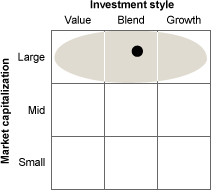
Index portfolio with exposure to large-capitalization U.S. stocks diversified across investment styles.

This is Equity/Stock Stylebox Image
Central Tendency legend

Central Tendency

Expected range legend

Expected range

How to read our stylebox
Fundamentals

FUNDAMENTAL2040
Number of stocks — —
Avg market cap — —
— —
Earnings growth rate — —
P/E ratio — —
P/B ratio — —
——
Return on equity — —
Foreign holdings — —

Holdings details

Sector categories are based on the Global Industry Classification Standard (“GICS”), except for the “Other” category (if applicable), which includes securities that have not been provided a GICS classification as of the effective reporting period.

* Percentages may not add up to 100%. SEC regulations allow us to withhold a certain amount of holdings as proprietary information.

The Trust is invested solely in the Institutional Select shares of the Vanguard 500 Index Fund. The Top 10 holdings reflects the holdings of the Fund.

Weighted exposures

as of  
error
Data not available for this Fund ID.

Sector categories are based on the Global Industry Classification Standard (“GICS”), except for the “Other” category (if applicable), which includes securities that have not been provided a GICS classification as of the effective reporting period.


The composition of the portfolio's primary asset class. (i.e., for a bond fund, weighted exposures show the composition of the fund's bond allocation and will exclude other asset classes such as the short-term reserves).

Risk and volatility

as of
error
Data not available for this Fund ID.
error
Data not available for this Fund ID.

An investment in the trust could lose money over short or even long periods. You should expect the trust’s share price and total return to fluctuate within a wide range, like the fluctuations of the overall stock market. The trust’s performance could be hurt by:

  • Stock market risk: The chance that stock prices overall will decline. Stock markets tend to move in cycles, with periods of rising stock prices and periods of falling stock prices. The trust’s target index may, at times, become focused in stocks of a particular sector, category, or group of companies. Because the fund seeks to track its target index, the fund may underperform the overall stock market.
  • Investment style risk: The chance that returns from large-capitalization stocks will trail returns from the overall stock market. Large-cap stocks tend to go through cycles of doing better—or worse—than other segments of the stock market or the stock market in general. These periods have, in the past, lasted for as long as several years.
  • Sector risk: The chance that significant problems will affect a particular sector, or that returns from that sector will trail returns from the overall stock market. Daily fluctuations in specific market sectors are often more extreme or volatile than fluctuations in the overall market. Because a significant portion of the trust’s assets are in the information technology sector, the trust’s performance is impacted by the general condition of that sector. Companies in the information technology sector could be affected by, among other things, overall economic conditions, short product cycles, rapid obsolescence of products, competition, and government regulation.
  • Nondiversification risk: Because the trust seeks to closely track the composition of the target index, from time to time, more than 25% of the trust's total assets may be invested in issuers representing more than 5% of the trust's total assets due to an index rebalance or market movement. As a result, trust performance may be hurt disproportionately by the poor performance of relatively few stocks, or even a single stock, and the trust’s shares may experience significant fluctuations in value.
  • Index-related risks: The fund is subject to risks associated with index investing, which include passive management risk, tracking error risk, and index provider risk. Passive management risk is the chance that the fund's use of an indexing strategy will negatively impact the fund's performance. Because the fund seeks to track the performance of its target index regardless of how that index is performing, the fund's performance may be lower than it would be if the fund were actively managed. Tracking error risk is the chance that the fund's performance will deviate from the performance of its target index. Tracking error risk may be heightened during times of increased market volatility or under other unusual market conditions. Index provider risk is the chance that the fund will be negatively impacted by changes or errors made by the index provider. Any gains, losses, or costs associated with or resulting from an error made by the index provider will generally be borne by the fund and, as a result, the fund's shareholders.

Vanguard Institutional 500 Index Trust is not a mutual fund. It is a collective trust available only to tax-qualified plans and their eligible participants. Investment objectives, risks, charges, expenses, and other important information should be considered carefully before investing. The collective trust is managed by Vanguard Fiduciary Trust Company, a wholly owned subsidiary of The Vanguard Group, Inc.

Management

Vanguard Institutional 500 Index Trust seeks to track the investment performance of the Standard & Poor’s 500 Index, an unmanaged benchmark representing U.S. large-capitalization stocks.

Proxy voting

This fund is eligible for Investor Choice.

Through the Investor Choice program, investors can select from a set of policies to help direct the proxy voting at the portfolio companies held by the fund. View policies

The policy adopted by the fund's trustees will be applied for all shares held by investors who have not yet made a policy selection through the Investor Choice program. Fund proxy policy

Proxy voting record

Please refer to the Literature section below to access the Statement of Additional Information (SAI), which details the fund's approach to proxy voting.

Literature


error

Data is unavailable at this time. Please try again later.