
Overview

Vanguard Short-Term Government Securities Active Fund seeks to provide current income with limited price volatility.


Investment approach


  • Short-term debt securities issued by the U.S. government and its agencies and instrumentalities.
  • Primarily invested in U.S. Treasury securities and agency-backed securitized products.
  • Seeks current income with limited price volatility.
  • Average maturity of 1–4 years.
  • Negligible credit risk and limited exposure to interest rate risk.
Learn more
Investment Tools

Investment Tools

Access fund data to perform in-depth analysis

Fund facts


as of 05/28/2026
0.10%
YTD Returns (NAV)
as of 11/17/2026
0.66%

30 day as of 11/16/2026 
4.74%

as of 10/31/2026
4.45%
Inception date
02/12/2001

$4.4B

$4.1B
Fund number
0549
CUSIP
922031844
Designation
Short-Term Bond
Benchmark
Bloomberg U.S. 1-5 Year Government Bond Index
Fees & minimum


None

None
Minimum investment
$50.0 K

Performance

Total returns

:
0.10%
RECENT RETURNS
AVERAGE ANNUAL
RECENT RETURNS and AVERAGE ANNUAL chart for VSGDX. Navigate to the performance summary table below for detailed values.
Month-endYTD1 YEAR3 YEAR5 YEAR10 YEAR
VSGDX (NAV)
———————
———————
———————
*Includes U.S. Treasury and agency obligations with maturities of 1 to 5 years.
YEAR1ST QUARTER2ND QUARTER3RD QUARTER4TH QUARTER
error
Data not available for this Fund ID.
YEAR
error
Data not available for this Fund ID.
AS OF 1 MONTH3 MONTHYTD AS OF
YTD AS OF
1 YEAR3 YEAR5 YEAR10 YEAR
VSGDX (NAV)
error
Data not available for this Fund ID.

Quarterly commentary

  • For the three months ended September 30, 2026, U.S. bonds posted negative returns as Treasury yields rose and bond prices declined. The Federal Reserve raised interest rates in September amid persistently elevated inflation.
  • Global bonds returned –2.46% for the quarter, as measured by the Bloomberg Global Aggregate Index. U.S. bonds fared a little worse than the broader global bond market.
  • U.S. Treasury yields rose across the curve in the third quarter. On the short end, the 3-month Treasury yield increased 35 basis points (bps) to 4.12%, the 6-month Treasury yield increased 37 bps to 4.33%, and the 2-year Treasury yield increased 71 bps to 4.89%. (A basis point is one hundredth of a percentage point.)
  • Vanguard Short-Term Government Securities Active Fund slightly underperformed its benchmark, the Bloomberg US 1–5 Year Government Bond Index (–0.87%). At quarter-end, the index consisted of approximately 98% Treasury securities and 2% government agency securities. Positions in agencies and agency commercial mortgage-backed securities (CMBS) contributed to returns over the quarter. Agency mortgage-backed securities (MBS) detracted from performance.
  • For the 12 months ended September 30, 2026, the curve flattened as the 2-year Treasury yield increased 128 bps and the 10-year Treasury yield increased 114 bps. Over this period, the fund outperformed its benchmark (+0.65%). Positions in agencies and agency CMBS drove outperformance. The fund’s duration strategy also contributed to performance.

Note: Changes in yields may reflect rounding.

The performance data shown represents past performance, which is not a guarantee of future results. Investment returns and principal value will fluctuate, so that investors' shares, when sold, may be worth more or less than their original cost. Current performance may be lower or higher than the performance data cited.
Performance data for periods of less than one year does not reflect the deduction of purchase and redemption fees. Maintenance, low balance, and service fees may be assessed by some funds. None of these fees are reflected in the performance figures. If these fees were included, the performance would be lower. All other performance data are adjusted for purchase and redemption fees, where applicable.
The performance of an index is not an exact representation of any particular investment, as you cannot invest directly in an index. Benchmark comparative indexes represent unmanaged or average returns on various financial assets, which can be compared with funds' total returns for the purpose of measuring relative performance.

Price & Distributions

Closing price

Closing price as of

NAV
NAV change
52-week high
52-week low
52-week difference

Realized/Unrealized gains

as of

Realized gain
Distribution schedule
Quarterly
Unrealized gains of NAV
Fiscal year-end date

Distribution

Use this table to view or export up to ten years of distributions for this fund.

No distribution records available.
error
Data not available for this Fund ID.

Portfolio


Style box


BONDS


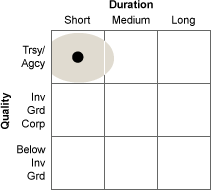
Portfolio of short-term government securities.

This is Bond/Fixed Income Stylebox Image
Central Tendency legend

Central Tendency

Expected range legend

Expected range

How to read our stylebox
Fundamentals

FUNDAMENTALVSGDX
Number of bonds — —
Yield to Maturity — —
Average duration — —
Average coupon — —

Holdings details

* Percentages may not add up to 100%. SEC regulations allow us to withhold a certain amount of holdings as proprietary information.

Weighted exposures

as of  
error
Data not available for this Fund ID.
error
Data not available for this Fund ID.

Credit-quality ratings are measured on a scale that generally ranges from AAA (highest) to D (lowest). “NR” is used to classify securities for which a rating is not available. NR securities may include internal money market funds, derivatives, and futures. U.S. Treasury, U.S. agency, and U.S. agency mortgage-backed securities appear under “U.S. Government.” Credit-quality ratings for each issue are either obtained from Bloomberg using ratings derived from Moody’s Investors Service (Moody’s), Fitch Ratings (Fitch), and Standard & Poor’s (S&P), or directly from Moody’s and S&P. Credit-quality ratings obtained from Bloomberg use the following methodologies: When ratings from all three agencies are available, the median rating is used; when ratings from only two of the agencies are available, the lower rating is used; and when one rating is available, that rating is used. Credit-quality ratings obtained directly from Moody’s and S&P use the higher rating for each issue. Exposures are calculated using investment book of record positions, which is based on when transactions occur, not when they settle, which can lead to the appearance of temporary negative cash balances or gross exposures greater than 100%.

error
Data not available for this Fund ID.

The composition of the portfolio's primary asset class. (i.e., for a bond fund, weighted exposures show the composition of the fund's bond allocation and will exclude other asset classes such as the short-term reserves).

Risk and volatility

as of
error
Data not available for this Fund ID.
error
Data not available for this Fund ID.

As with any investment, an investment in the fund could lose money over any time period. The fund’s share price and total return may fluctuate, potentially within a wide range. The principal risks of investing in the fund are summarized below. Each of the following risks could affect the fund’s performance:

  • General Market Risk. The markets in which the fund invests can be affected by a variety of factors. These factors, which can be real or perceived, may include economic, market, political, and regulatory conditions and developments as well as local, regional, or global events such as wars, military conflicts, natural disasters, and public health issues. In addition, investor sentiment and expectations regarding these factors can also impact the markets. Different parts of the market, including different industries and sectors as well as different types of securities, may react differently to factors that affect the market. These factors can contribute to market uncertainty, market volatility, and fluctuations in the value of the fund’s investments, thereby resulting in potential losses to the fund over short or long periods.
  • Investing in Bond Markets. The fund may be impacted by the general condition of the bond markets and by factors that affect bonds and bond issuers. For example, as a general rule, bond prices and interest rates move in opposite directions. When interest rates rise, bond prices tend to fall, and when interest rates fall, bond prices tend to go up. Bond income also is affected by changes in interest rates. Interest rates can rise or fall for a number of reasons, including, but not limited to, central bank monetary policy, inflationary or deflationary pressures, and changes in general market and economic conditions. Changing interest rates, including, but not limited to, rates that fall below zero, could have unpredictable effects on the overall market and may expose the bond markets in particular to heightened volatility and potential illiquidity. The degree to which the fund is impacted by certain bond market risks may vary based on factors disclosed in its principal investment strategies, such as the types of bonds in which it invests and the overall credit quality, average maturity, and/or average duration of its bond holdings.
  • Interest Rate Risk. During periods of rising interest rates, bond prices overall may decline, which could result in a decline in the fund’s value. The prices of longer-term bonds are more sensitive to changes in interest rates than the prices of shorter-term bonds.
  • Income Risk. During periods of falling interest rates, the fund’s income may decline. The income paid by shorter-term bonds is subject to a higher degree of fluctuation than the income paid by longer-term bonds.
  • Credit Risk. Credit risk refers to the chance that an issuer will default (fail to meet its credit obligations) or fail to make payments in a timely manner, which could result in a loss to the fund. In addition, negative perceptions of an issuer’s ability to make payments can cause the price of a security to decline. While all debt securities are subject to credit risk to some extent, those with higher credit quality ratings generally pose less credit risk than those with lower credit quality ratings.
  • Bond Liquidity Risk. If the fund is unable to sell a security at an advantageous time or price, its returns may be reduced. There may be limited trading in the secondary market for certain debt securities, which could make them more difficult to value or sell.
  • Prepayment Risk. Certain bonds are subject to risks associated with prepayment. With respect to mortgage-backed, asset-backed, and similar debt securities, prepayment typically refers to borrowers repaying their debt early (e.g., before the maturity date). Prepayment of bonds held by the fund would result in the fund losing any price appreciation above the amount repaid. In addition, because prepayments occur more frequently in low interest rate environments, the fund likely would be forced to reinvest the proceeds from any prepayments at a lower interest rate than when the prepaid bonds were purchased, resulting in a decline in the fund’s income and a potential loss in the value of the fund’s investments. Frequent prepayments and subsequent reinvestment of the proceeds also would increase the fund’s turnover rate.
  • Extension Risk. During periods of rising interest rates, certain bonds held by the fund may be paid off substantially more slowly than originally anticipated. As a result, the value of the bonds may fall, resulting in a decline in the fund’s income and a potential loss in the value of the fund’s investments.
  • TBA Mortgage-Backed Securities. A TBA transaction represents an agreement to buy or sell mortgage-backed securities with agreed-upon characteristics for a fixed unit price at a future date, but does not specify the particular security to be delivered. TBA transactions are subject to the risk that the values of the mortgage-backed securities that the fund has agreed to purchase will decline prior to the settlement date or that the counterparty will not deliver the securities as promised.
  • Active Management. The fund is actively managed. The advisor’s security selection and/or strategy execution could cause the fund to underperform relevant securities markets or other funds with a similar investment objective.
  • Investing in Derivatives. Investing in derivatives may present risks different from, and/or greater than, those associated with investing directly in stocks, bonds, or other types of investments. Derivatives could expose the fund to increased volatility and/or significant loss. Certain derivatives have an inherent leverage component, providing the fund exposure to a sizable position in an underlying asset with a relatively small upfront investment at the time the fund enters into the derivatives position. For these derivatives, an adverse change in the value or price of the underlying asset could result in a loss substantially greater than the amount invested in the derivative itself. Some derivatives require the fund to enter into a contract with a counterparty. If the counterparty is unable or unwilling to fulfill its contractual obligation, the fund may experience a loss. A liquid market may not always exist for the fund’s derivatives positions. The fund may be unable to sell or otherwise exit its derivatives position at desired times or prices, which could also result in a loss to the fund. Some derivatives, particularly OTC derivatives, can be complex and often are valued subjectively. Valuation may be more difficult in times of market turmoil since many investors and market makers may be reluctant to purchase complex instruments or quote prices for them. Improper valuations can result in increased cash payment requirements to counterparties or a loss of value to the fund.
    Derivatives may not perform as intended, which may result in losses to the fund. For example, derivatives used for hedging or as a substitute for a portfolio instrument may not provide the expected benefits, particularly during adverse market conditions. The use of derivatives is also subject to legal risk, which includes the risk of loss resulting from insufficient or unenforceable contractual documentation, insufficient capacity or authority of the fund’s counterparty, and operational risk, which includes documentation or settlement issues, system failures, inadequate controls, and human error.
  • Short Selling. The fund may lose money in connection with its short sales of certain securities and/or derivatives. In a short sale, the fund sells a security that it does not own and “borrows” the security from a third-party in order to settle the transaction with the original buyer. The fund later repurchases the security on the open market and returns it to the third party. The fund can profit from a short sale if the price of the borrowed security declines before the fund repurchases it. However, there is no guarantee that the price of the borrowed security will decline. In fact, the security’s price may rise, which would increase the cost to the fund to repurchase the security and ultimately result in a loss to the fund. Because there is no upward limit on how high the price of a borrowed security could rise, the fund’s potential for loss in connection with a short sale is theoretically unlimited.

Management

Vanguard Short-Term Government Securities Active Fund seeks to provide current income while maintaining limited price volatility. Under normal circumstances, the fund will invest at least 80% of its assets in short-term bonds issued or guaranteed by the U.S. government and its agencies and instrumentalities, many of which are not backed by the full faith and credit of the U.S. government. The fund is expected to maintain a dollar-weighted average maturity of 1 to 4 years.


Alexander Payne, CFA,Portfolio manager.

  • Advised the fund since 2026.
  • Worked in investment management since 2006.
  • B.A., Dartmouth College.

Brian Quigley, CFA,Portfolio manager.

  • Advised the fund since 2015.
  • Worked in investment management since 2005.
  • B.S., Lehigh University.

Nathan Persons,Portfolio manager.

  • Advised the fund since 2025.
  • Worked in investment management since 2008.
  • B.S., Delaware Valley University.
  • M.B.A., Temple University.

Literature


error

Data is unavailable at this time. Please try again later.