Launched in 1975, The Vanguard Group, Inc., Malvern, Pennsylvania, is among the world’s largest equity and fixed income managers. Vanguard’s wholly owned subsidiary, Vanguard Capital Management, an independent investment advisor designed to enhance fund oversight and operational efficiency, is focused on equity, fixed income, and multi-asset strategies. Equity index funds are managed by Global Equity Index Management, covering U.S. and international markets. Global Equity Index Management has developed sophisticated portfolio construction methodologies and efficient trading strategies that seek to deliver returns that are highly correlated with target portfolio benchmarks. The group has advised Vanguard Target Retirement 2025 Fund since 2003.
Overview
Vanguard Target Retirement 2025 Fund seeks to provide capital appreciation and current income consistent with its current asset allocation.
Investment approach
- Simple fund of funds structure seeks to build appropriate asset allocation from preselected stock and bond portfolios.
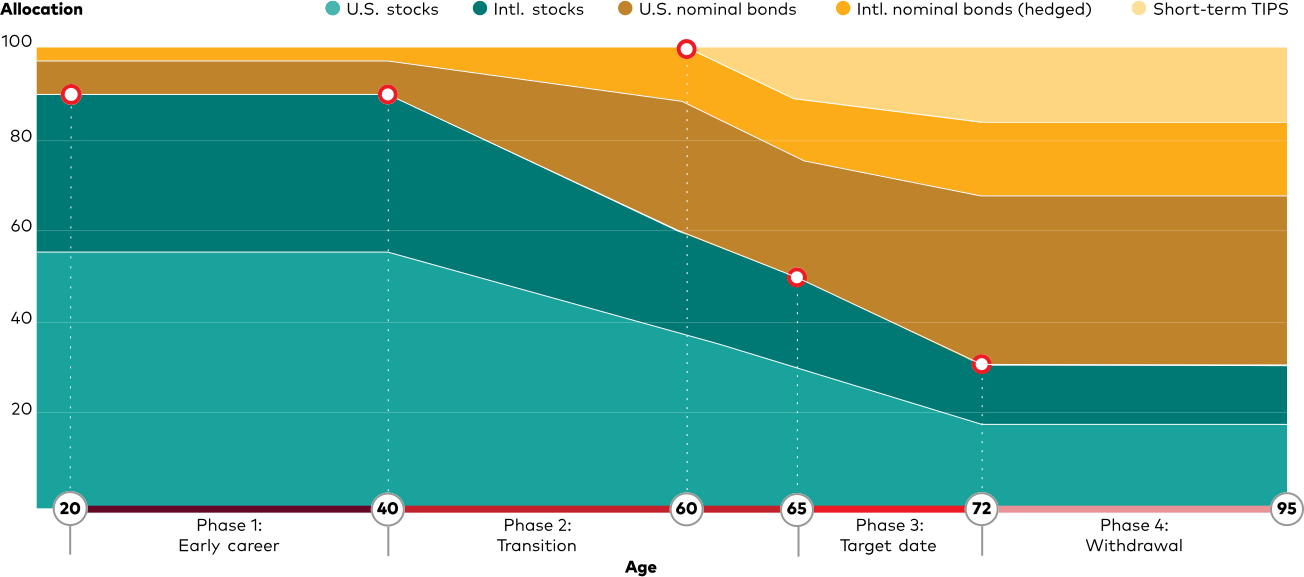
- The allocation between funds and asset classes automatically becomes more conservative over time.
- The fund handles investment selection, asset allocation, and rebalancing through retirement.
- 100% of assets invested in index funds.

Investment Tools
Access fund data to perform in-depth analysis
Fund facts
as of 01/28/2026 | 0.08% |
|---|---|
| YTD Returns (NAV) as of 11/20/2026 | 1.30% |
30 day as of 10/31/2026 | 3.04% |
as of 10/31/2026 | 1.64% |
| Inception date | 10/27/2003 |
| $70.8B | |
| $70.8B | |
| Fund number | 0304 |
| CUSIP | 92202E409 |
| Designation | Target-Date 2021-2025 |
| Benchmark | Target Retirement 2025 Composite Index |
Fees & minimum
| None | |
| None | |
| Minimum investment | $1.0 K |
Glidepath
Performance
Total returns
0.08%
RECENT RETURNS
AVERAGE ANNUAL
| Month-end | YTD | 1 YEAR | 3 YEAR | 5 YEAR | 10 YEAR | ||
|---|---|---|---|---|---|---|---|
VTTVX (NAV) | — | — | — | — | — | — | — |
| — | — | — | — | — | — | — | |
| — | — | — | — | — | — | — |
*Derived by applying the fund’s target asset allocation to the results of the following benchmarks: for international stocks of developed markets, the MSCI EAFE Index through December 15, 2010, the MSCI ACWI ex USA IMI Index through June 2, 2013, and the FTSE Global All Cap ex US Index thereafter; for emerging-market stocks, the Select Emerging Markets Index through August 23, 2006, the MSCI Emerging Markets Index through December 15, 2010, the MSCI ACWI ex USA IMI Index through June 2, 2013, and the FTSE Global All Cap ex US Index thereafter; for U.S. bonds, the Bloomberg U.S. Aggregate Bond Index through December 31, 2009, and the Bloomberg U.S. Aggregate Float Adjusted Index thereafter, as well as the Bloomberg U.S. Treasury Inflation-Protected Securities (TIPS) 0-5 Year Index; for international bonds, the Bloomberg Global Aggregate ex-USD Float Adjusted RIC Capped Index Hedged beginning June 3, 2013; and for U.S. stocks, the Dow Jones U.S. Total Stock Market Index (formerly known as the Dow Jones Wilshire 5000 Index) through April 22, 2005, the MSCI US Broad Market Index through June 2, 2013, and the Morningstar US Total Market Index thereafter. International stock benchmark returns are adjusted for withholding taxes.
| YEAR | 1ST QUARTER | 2ND QUARTER | 3RD QUARTER | 4TH QUARTER |
|---|
| YEAR |
|---|
| AS OF | 1 MONTH | 3 MONTH | YTD AS OF | YTD AS OF | 1 YEAR | 3 YEAR | 5 YEAR | 10 YEAR | |
|---|---|---|---|---|---|---|---|---|---|
VTTVX (NAV) | |||||||||
The performance data shown represents past performance, which is not a guarantee of future results. Investment returns and principal value will fluctuate, so that investors' shares, when sold, may be worth more or less than their original cost. Current performance may be lower or higher than the performance data cited.
Performance data for periods of less than one year does not reflect the deduction of purchase and redemption fees. Maintenance, low balance, and service fees may be assessed by some funds. None of these fees are reflected in the performance figures. If these fees were included, the performance would be lower. All other performance data are adjusted for purchase and redemption fees, where applicable.
The performance of an index is not an exact representation of any particular investment, as you cannot invest directly in an index. Benchmark comparative indexes represent unmanaged or average returns on various financial assets, which can be compared with funds' total returns for the purpose of measuring relative performance.
Investments in Target Retirement Funds are subject to the risks of their underlying funds. The year in the Fund name refers to the approximate year (the target date) when an investor in the Fund would retire and leave the work force. The Fund will gradually shift its emphasis from more aggressive investments to more conservative ones based on its target date. An investment in the Target Retirement Fund is not guaranteed at any time, including on or after the target date.
Price & Distributions
Closing price
Closing price as of
NAV
NAV change
52-week high
52-week low
52-week difference
Realized/Unrealized gains
as of
Realized gain
Distribution schedule
Quarterly
Unrealized gains of NAV
Fiscal year-end date
Distribution
Use this table to view or export up to ten years of distributions for this fund.
No distribution records available.
Portfolio
Style box
Risk and volatility
as of
As with any investment, an investment in the fund could lose money over any time period. The fund’s share price and total return may fluctuate, potentially within a wide range. The principal risks of investing in the fund are summarized below. Each of the following risks could affect the fund’s performance:
- General Market Risk. The markets in which the fund and the underlying funds invest can be affected by a variety of factors. These factors, which can be real or perceived, may include economic, market, political, and regulatory conditions and developments as well as local, regional, or global events such as wars, military conflicts, natural disasters, and public health issues. In addition, investor sentiment and expectations regarding these factors can also impact the markets. Different parts of the market, including different industries and sectors as well as different types of securities, may react differently to factors that affect the market. These factors can contribute to market uncertainty, market volatility, and fluctuations in the value of the fund’s investments, thereby resulting in potential losses to the fund over short or long periods.
- Investing in Equity Markets. Certain underlying funds invest in the equity markets. Equity markets have historically been cyclical, having periods of time when stock values rise and fall. Market volatility can lead to significant fluctuations in stock values, resulting in potential losses to these underlying funds.
- Market Capitalization (Market Cap). Companies are generally classified into three types of market cap depending on their size: small-, mid-, and large-cap. Companies can be further classified into micro- or mega-cap. Different factors can affect each market cap uniquely, and historically small-and mid-cap stocks have typically been more volatile due to the effects of changing economic conditions. Large companies may not reach the same levels of growth or performance as smaller companies, and they may be slower to react to competitive challenges. The performance of funds that invest in a subset of market caps could diverge from the performance of a fund that is focused on a broader representation of the stock market.
- Investing in Bond Markets. Certain underlying funds invest in bonds. As a result, these underlying funds may be impacted by the general condition of the bond markets and by factors that affect bonds and bond issuers. For example, as a general rule, bond prices and interest rates move in opposite directions. When interest rates rise, bond prices tend to fall, and when interest rates fall, bond prices tend to go up. Bond income also is affected by changes in interest rates. Interest rates can rise or fall for a number of reasons, including, but not limited to, central bank monetary policy, inflationary or deflationary pressures, and changes in general market and economic conditions. Changing interest rates, including, but not limited to, rates that fall below zero, could have unpredictable effects on the overall market and may expose the bond markets in particular to heightened volatility and potential illiquidity. The degree to which an underlying fund is impacted by certain bond market risks may vary based on factors disclosed in its principal investment strategies, such as the types of bonds in which it invests and the overall credit quality, average maturity, and/or average duration of its bond holdings.
- Interest Rate Risk. During periods of rising interest rates, bond prices overall may decline, which could result in a decline in an underlying fund’s value. The prices of longer-term bonds are more sensitive to changes in interest rates than the prices of shorter-term bonds.
- Income Risk. During periods of falling interest rates, the fund’s and/or an underlying fund’s income may decline. The income paid by shorter-term bonds is subject to a higher degree of fluctuation than the income paid by longer-term bonds.
- Credit Risk. Credit risk refers to the chance that an issuer will default (fail to meet its credit obligations) or fail to make payments in a timely manner, which could result in a loss to an underlying fund. In addition, negative perceptions of an issuer’s ability to make payments can cause the price of a security to decline. While all debt securities are subject to credit risk to some extent, those with higher credit quality ratings generally pose less credit risk than those with lower credit quality ratings.
- Bond Liquidity Risk. If an underlying fund is unable to sell a security at an advantageous time or price, its returns may be reduced. There may be limited trading in the secondary market for certain debt securities, which could make them more difficult to value or sell.
- Call Risk. Certain bonds held by an underlying fund may be callable. The issuer of a callable bond has the right to “call” (redeem) the bond before its maturity date. Calls on bonds held by an underlying fund would result in the underlying fund losing any price appreciation above the bond’s call price. In addition, because bond calls occur more frequently during periods of falling interest rates, the underlying fund likely would be forced to reinvest the proceeds of any called bonds at a lower interest rate than that of the called bonds, resulting in a decline in the underlying fund’s income and a potential loss in the value of the underlying fund’s investments. Frequent bond calls and subsequent reinvestments of the proceeds also would increase an underlying fund’s turnover rate.
- Prepayment Risk. Certain bonds held by the underlying funds are subject to risks associated with prepayment. Prepayment risk for callable bonds is described under Call Risk. With respect to mortgage-backed, asset-backed, and similar debt securities, prepayment typically refers to borrowers repaying their debt early (e.g., before the maturity date). Prepayment of bonds held by an underlying fund would result in the underlying fund losing any price appreciation above the amount repaid (or the bond’s call price, in the case of callable bonds). In addition, because prepayments occur more frequently in low interest rate environments, the underlying fund likely would be forced to reinvest the proceeds from any prepayments at a lower interest rate than when the prepaid bonds were purchased, resulting in a decline in the underlying fund’s income and a potential loss in the value of the underlying fund’s investments. Frequent prepayments and subsequent reinvestment of the proceeds also would increase the underlying fund’s turnover rate.
- Extension Risk. During periods of rising interest rates, certain bonds held by an underlying fund may be paid off substantially more slowly than originally anticipated. As a result, the value of the bonds may fall, resulting in a decline in an underlying fund’s income and a potential loss in the value of an underlying fund’s investments.
- Inflation-Indexed Securities. Because they are adjusted for inflation, TIPS and other inflation-indexed securities typically have lower yields than conventional bonds. As a result of its investment in such securities, the underlying fund’s income distributions are likely to fluctuate considerably more than the income distributions of a conventional bond fund. In fact, under certain conditions, the underlying fund may not have income to distribute at all. Although the prices of inflation-indexed securities are not meaningfully affected by changes in “nominal” (stated) interest rates, their prices may decline when “real” (adjusted for inflation) interest rates rise, and vice versa. The prices of inflation-indexed securities also are subject to decline if prices throughout the U.S. economy decline over time (a period of deflation), which could result in a loss to the fund and/or cause the fund’s performance to lag that of conventional bond funds.
- Investing in Foreign Markets. Foreign markets can perform differently than U.S. markets. World events could adversely affect the value and/or liquidity of securities of foreign companies or foreign issuers, potentially in ways that differ from impacts to U.S. companies or issuers. Further, global economies and financial markets are becoming increasingly interconnected, which increases the possibility that conditions in one country or region could adversely impact a different country or region. In addition, the rights and remedies associated with investments in a fund that invests in foreign securities may be different than a fund that invests in domestic securities. To the extent that the underlying funds invest a large portion of their assets in securities of companies located primarily in one country or region, the fund’s performance may be hurt disproportionately by the poor performance of the underlying funds’ investments in such country or region.
- Currency Risk. Certain underlying funds are subject to the risk that foreign currency will perform differently than U.S. dollars and increase the potential loss to an underlying fund. Currency exchange rates may be volatile, move rapidly, and change as a result of changes in interest rates, inflation rates, government surpluses or deficits, and monetary policy or currency controls imposed by local governments or supranational entities such as the International Monetary fund. Changes in currency exchange rates can affect the value of an underlying fund’s holdings.
- Currency Hedging. Certain underlying funds may attempt to offset currency risk through a hedging strategy; however, by doing so, these underlying funds may not be able to capture gains that they could otherwise realize if they did not have a hedging strategy. It generally is not possible to perfectly hedge the risk posed by foreign currency exposure. Hedging transactions can increase transaction costs and subject an underlying fund to the risk that a counterparty is unable to fulfill its contractual obligation, in which case the underlying fund could be subject to additional loss.
- Underlying Funds Risk. The fund invests substantially all of its assets in underlying funds. This means that the fund is exposed to all of the risks associated with the investment strategies and policies of those underlying funds, including the risk that the underlying funds will not meet their investment objectives.
- Allocation to Underlying Funds. The advisor’s selection of underlying funds, and the allocation of a high percentage of the fund’s assets to a relatively few number of underlying funds, may cause the fund to be hurt disproportionately by the poor performance of any one underlying fund or to underperform other funds with a similar investment objective.
Management
Vanguard Target Retirement 2025 Fund uses an asset allocation strategy designed for investors planning to retire between 2023 and 2027. The fund seeks to provide growth of capital and current income consistent with its current target allocation by investing in a gradually more conservative mix of the following Vanguard funds: Total Stock Market Index Fund, Total Bond Market II Index Fund, Total International Stock Index Fund, Total International Bond II Index Fund, and Short-Term Inflation-Protected Securities Fund. The combination of funds produces a portfolio that is diversified by asset class and holdings.
Vanguard Target Retirement 2025 Fund is one of a series of Vanguard funds that use a targeted maturity approach as a simplified way to meet investors’ different objectives, time horizons, and changing risk tolerances. As your retirement date approaches, the fund’s allocation will grow more conservative and will begin to invest in the Vanguard Short-Term Inflation-Protected Securities Index Fund to provide a hedge against inflation while dampening the overall volatility of the portfolio. In this regard, the fund diversifies both stock and conventional bond exposure. Within seven years after 2025, the fund’s asset allocation should resemble that of the Target Retirement Income Fund.
Quarterly commentary