Launched in 1975, The Vanguard Group, Inc. (VGI), Malvern, Pennsylvania, is among the world’s largest equity and fixed income managers. VGI’s wholly-owned subsidiary, Vanguard Fiduciary Trust Company (VFTC), manages Vanguard’s collective investment trust mandates. The group has advised Vanguard Russell 1000 Value Index Trust since 2003.
Overview
Vanguard Russell 1000 Value Index Trust seeks to track the performance of the Russell 1000 Value Index, an unmanaged benchmark that measures the investment return of large- and mid-capitalization value stocks.
Investment approach
- Seeks to track the performance of the Russell 1000 Value Index.
- Large- and mid-cap value equity invested in a commingled trust.
- Passively managed, full-replication approach.
- Trust remains fully invested.
- Low expenses minimize net tracking error.
Benchmark
- The Russell 1000 Value Index measures the performance of the large-cap value segment of the U.S. equity universe.
- It includes those Russell 1000 companies with lower price-to-book ratios and lower expected and historical growth rates.

Investment Tools
Access fund data to perform in-depth analysis
Fund facts
| YTD Returns (NAV) as of 11/17/2026 | 23.74% |
|---|---|
| — | |
as of 10/31/2026 | 1.59% |
| Inception date | 09/30/2003 |
| $4.6B | |
| $4.6B | |
| Fund number | 0191 |
| CUSIP | 92202V880 |
| Designation | Domestic Large Value |
| Benchmark | Russell 1000 Value Index |
Fees & minimum
| None | |
| None | |
| Minimum investment |
Performance
Total returns
RECENT RETURNS
AVERAGE ANNUAL
| Month-end | YTD | 1 YEAR | 3 YEAR | 5 YEAR | 10 YEAR | ||
|---|---|---|---|---|---|---|---|
0191 (NAV) | — | — | — | — | — | — | — |
| — | — | — | — | — | — | — | |
| — | — | — | — | — | — | — |
Collective Trust returns are computed taking into account all trading costs, but do not reflect the deduction of other costs or fees, including investment advisory fees. The collective trusts are managed by Vanguard Fiduciary Trust Company, a subsidiary of The Vanguard Group, Inc.
*Measures the performance of those Russell 1000 companies with lower price/book ratios and lower predicted and historical growth rates.
| YEAR | 1ST QUARTER | 2ND QUARTER | 3RD QUARTER | 4TH QUARTER |
|---|
| YEAR |
|---|
| AS OF | 1 MONTH | 3 MONTH | YTD AS OF | YTD AS OF | 1 YEAR | 3 YEAR | 5 YEAR | 10 YEAR | |
|---|---|---|---|---|---|---|---|---|---|
0191 (NAV) | |||||||||
The performance data shown represents past performance, which is not a guarantee of future results. Investment returns and principal value will fluctuate, so that investors' shares, when sold, may be worth more or less than their original cost. Current performance may be lower or higher than the performance data cited.
Performance data for periods of less than one year does not reflect the deduction of purchase and redemption fees. Maintenance, low balance, and service fees may be assessed by some funds. None of these fees are reflected in the performance figures. If these fees were included, the performance would be lower. All other performance data are adjusted for purchase and redemption fees, where applicable.
The performance of an index is not an exact representation of any particular investment, as you cannot invest directly in an index. Benchmark comparative indexes represent unmanaged or average returns on various financial assets, which can be compared with funds' total returns for the purpose of measuring relative performance.
Price & Distributions
Closing price
Closing price as of
NAV
NAV change
52-week high
52-week low
52-week difference
Portfolio
Market capitalization
as of 10/31/2026| MARKET SIZE | 0191 | +/- WEIGHT | |
|---|---|---|---|
| Large | — | — | — |
| Medium/Large | — | — | — |
| Medium | — | — | — |
| Medium/Small | — | — | — |
| Small | — | — | — |
More information about market capitalization
Style box
Stocks
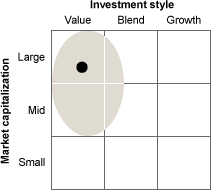
Index portfolio of large- and mid-capitalization value stocks.

Central Tendency

Expected range
Fundamentals
| FUNDAMENTAL | 0191 | |
|---|---|---|
| Number of stocks | — | — |
| Avg market cap | — | — |
| — | — | |
| Earnings growth rate | — | — |
| P/E ratio | — | — |
| P/B ratio | — | — |
| — | — | |
| Return on equity | — | — |
| Foreign holdings | — | — |
Holdings details
As of date
Sector categories are based on the Industry Classification Benchmark system (“ICB”), except for the “Other” category (if applicable), which includes securities that have not been provided an ICB classification as of the effective reporting period.
* Percentages may not add up to 100%. SEC regulations allow us to withhold a certain amount of holdings as proprietary information.
Weighted exposures
as ofSector categories are based on the Industry Classification Benchmark system (“ICB”), except for the “Other” category (if applicable), which includes securities that have not been provided an ICB classification as of the effective reporting period.
The composition of the portfolio's primary asset class. (i.e., for a bond fund, weighted exposures show the composition of the fund's bond allocation and will exclude other asset classes such as the short-term reserves).
Risk and volatility
as of
An investment in the trust portfolio could lose money over short or even long periods. You should expect the portfolio’s share price and total return to fluctuate within a wide range, like the fluctuations of the overall stock market. The portfolio’s performance could be hurt by:
- Stock market risk: The chance that stock prices overall will decline. Stock markets tend to move in cycles, with periods of rising stock prices and periods of falling stock prices. The fund’s target index may, at times, become focused in stocks of a particular sector, category, or group of companies. Because the fund seeks to track its target index, the fund may underperform the overall stock market.
- Investment style risk: The chance that returns from large-capitalization value stocks will trail returns from the overall stock market. Large-cap stocks tend to go through cycles of doing better—or worse—than other segments of the stock market or the stock market in general. These periods have, in the past, lasted for as long as several years.
- Index replicating risk, which is the chance that the fund may be prevented from holding one or more securities in the same proportion as in its target index.
- Index-related risks: The fund is subject to risks associated with index investing, which include passive management risk, tracking error risk, and index provider risk. Passive management risk is the chance that the fund's use of an indexing strategy will negatively impact the fund's performance. Because the fund seeks to track the performance of its target index regardless of how that index is performing, the fund's performance may be lower than it would be if the fund were actively managed. Tracking error risk is the chance that the fund's performance will deviate from the performance of its target index. Tracking error risk may be heightened during times of increased market volatility or under other unusual market conditions. Index provider risk is the chance that the fund will be negatively impacted by changes or errors made by the index provider. Any gains, losses, or costs associated with or resulting from an error made by the index provider will generally be borne by the fund and, as a result, the fund's shareholders.
Management
Vanguard Russell 1000 Value Index Trust seeks to track the investment performance of the Russell 1000 Value Index, an unmanaged benchmark of Russell 1000 companies with lower price-to-book ratios and lower forecasted growth characteristics. Using full replication, the portfolio holds each index stock in the same proportion as its weighting in the index. Vanguard Fiduciary Trust Company applies disciplined portfolio construction and efficient trading techniques designed to accommodate cash flows and maintain close alignment with benchmark characteristics. A refined indexing process and efficient trading have delivered tight tracking gross of expenses. Vanguard seeks profitable opportunities in securities lending, without exposing portfolio assets to undue risk. The trust’s securities-lending policy focuses on safety, allowing overnight loans only to the highest-quality institutions and requiring 102% collateral in the form of cash and U.S. government securities.
Proxy voting
This fund is eligible for Investor Choice.
Through the Investor Choice program, investors can select from a set of policies to help direct the proxy voting at the portfolio companies held by the fund. View policies
The policy adopted by the fund's trustees will be applied for all shares held by investors who have not yet made a policy selection through the Investor Choice program. Fund proxy policy
Please refer to the Literature section below to access the Statement of Additional Information (SAI), which details the fund's approach to proxy voting.
Quarterly commentary