


Gen Z and millennials on track
Workers in the Generation Z and millennial cohorts are on track to be better prepared for retirement than those in older generations, thanks to broader access to DC plans and stronger retirement plan design. Nearly half of Gen Z workers and 42% of millennials are projected to maintain their current standard of living in retirement, slightly ahead of the 40% projected for baby boomers approaching retirement.
While many young workers face significant debt burdens—student loans, auto loans, and credit card debt consume about a quarter of Gen Z and millennials’ income at the median—expanded DC plan access and improved plan features are helping them build retirement security. Continued progress will depend on how effectively they can balance their overall financial wellness.
“Younger workers are benefiting from better plan design features like autoenrollment, automatic escalation of saving rates over time, and investment in qualified default investment alternatives, but managing debt remains essential,” said Nicky Zhang, a Vanguard investment strategist and co-author of the research paper. “Supporting overall financial wellness with effective planning tools is key to helping the next generation achieve lasting retirement security.”
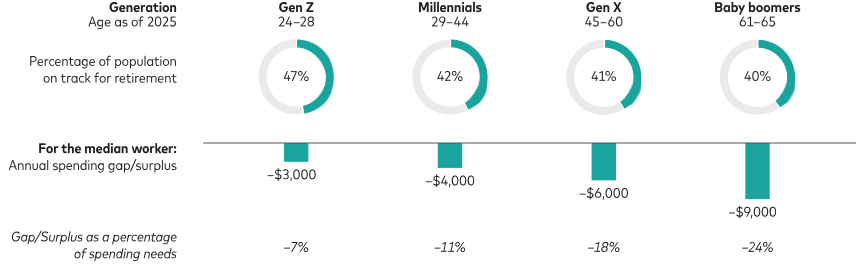
Note: We calculate the population share for each generation whose projected sustainable income exceeds spending needs during retirement.
Sources: Vanguard calculations, based on data from the Survey of Consumer Finances (SCF), the Health and Retirement Study (HRS), and the Social Security Administration (SSA).
DC plan access doubles retirement readiness
Across all generations, access to workplace retirement plans is a game changer. Workers with access to DC plans are nearly twice as likely to be on track for retirement (54%) compared with those without access (28%). These plans are transforming retirement outcomes, especially for younger generations, by making saving easier and more effective through features like autoenrollment, automatic escalation, and the ability to invest in target-date funds. According to previous Vanguard research, DC plan participation and eligibility rates are at all-time highs, helping more workers build long-term financial security.
Expanding access to workplace retirement plans could improve outcomes even further: If all workers had access to a DC plan, about 6 in 10 Americans would be on track for retirement.
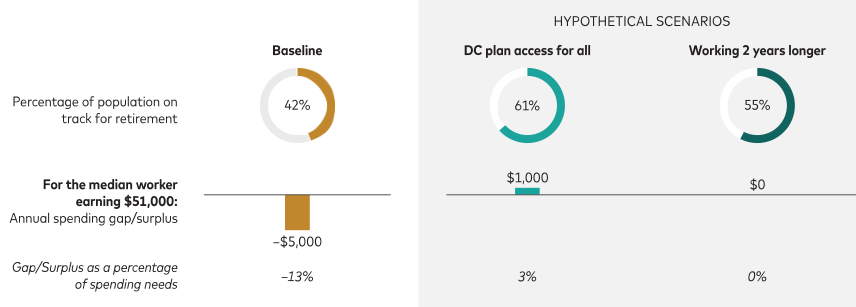
Note: For each scenario, we calculate the population share whose projected sustainable income exceeds their spending needs during retirement. In the “baseline” scenario, we assume workers retire and claim Social Security benefits at age 65 and that workers have different probabilities of future DC plan access based on their age and income. In the “DC plan access for all” scenario, we assume all workers have access to DC plans through their employers and therefore save at higher rates, and that workers retire and claim Social Security benefits at age 65. In the “working 2 years longer” scenario, we assume workers retire and claim Social Security benefits at age 67 and that workers have different probabilities of future DC plan access based on their age and income. Figures are based on 2022 dollars and rounded to the nearest thousand.
Sources: Vanguard calculations, based on data from the SCF, the HRS, and the SSA.
Covering baby boomer savings shortfalls
Among baby boomers approaching retirement, readiness varies widely by income. The top 30% of earners are generally well prepared, while many others may face significant gaps. The median baby boomer is projected to need to replace 31% of their pre-retirement income through private and employer retirement savings, with an annual shortfall of $9,000, or almost a quarter of their expenses.
To address potential spending gaps, baby boomers across income levels may need to consider options like tapping home equity, reducing spending, or working two additional years, if possible. Home equity can be a powerful lever across the income spectrum, especially for those in the lower 70% of the income distribution.
Practical steps to strengthen retirement readiness
The path forward for retirement readiness

Note:
All investing is subject to risk.