



Global Head of Investor Research and Policy,
Vanguard Investment Strategy Group
2 minutes 42 seconds
0:05 With increasing longevity, there are two potential implications.
0:09 First, workers will need to be prepared to fund a longer retirement or be prepared to work for longer.
0:16 There are two takeaways related to this that employers and workers should be thinking about.
0:21 First, how to prepare employees who will be funding a longer period in retirement.
0:27 This could mean autoenrolling people in the employer plan so that they are saving from day one.
0:33 We also need to make sure that they are taking full advantage of the employer match.
0:37 And finally, we could consider higher default savings rates.
0:41 These are some of the ways that employers can better equip their employees for retirement.
0:46 Second, and relatedly, we'd expect to see an increase in the number of workers who want to or need to work well into their 70s.
0:54 Here we could see solutions like providing increased flexibility and work schedules, more options to work remotely, and a focus on roles that leverage a more tenured employee’s extensive experience.
1:07 Firms who are proactively developing solutions for their employees in both of these areas will have a leg up on their peers in the fight to attract and retain talented employees.
1:18 We project that AI will be disruptive.
1:20 It’ll be a disruptive technology impacting perhaps four out of every five occupations.
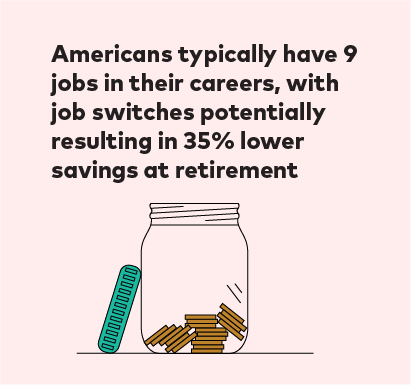
1:26 In that scenario, we'd expect an increase in occupational transitions, people moving from job to job.
1:32 More workers will be changing jobs more frequently as AI reshapes occupations.
1:38 Now, we know that job transitions are actually a weak link in our employer-based retirement system.
1:44 So employers can take a number of steps to help employees navigate this landscape while they're switching jobs to remain on track to achieve their retirement goal.
1:53 Some examples.
1:55 First, make savings rates more portable.
1:58 So when I'm switching jobs, I'm not necessarily defaulted into a lower default savings rate than I was saving in my last job.
2:06 We want people to maintain momentum in their savings rate as they move from job to job.
2:11 A second idea is to reduce eligibility and vesting timelines.
2:15 This is sort of the small print that exists in many plans where we'd love to be able to see people start saving on day one and keep their savings when they leave.
2:25 Finally, make it easier for job changers to keep their retirement savings invested in an age-appropriate target-date fund.

“Maximizing” the match for equity, savings, and cost
Smarter default savings rates
Automatic repayment for emergency withdrawals
A qualified default investment alternative (QDIA) for individual retirement accounts (IRAs)
Disclosures
1 Clark, Jeffrey W. and Kevin D. Kukulka (Vanguard 2023). Generational Changes in 401(k) Behaviors.
2 National evidence is documented in Choukhmane et al (2023). Who Benefits from Retirement Saving Incentives in the U.S.? Analysis of 1,365 plan records kept by Vanguard between 2013 and 2022 shows that top earners receive 43% of W-2 income and 39% percent of benefit income, compared with 44% of employer contributions.
3 Indeed, the most common default savings rate is still just 3% (Vanguard 2023).
4 Bureau of Labor Statistics, 2022. Current population survey.
5 Beshears et al. (2024). Does 401(k) Loan Repayment Crowd Out Retirement Saving? Evidence from Administrative Data and Implications for Plan Design.
6 There was $12.7 trillion in IRA accounts in 2020, according to IRS SOI Tax Stats Accumulation and Distribution of Individual Retirement Arrangements. In 2021, according to the Employee Benefit Research Institute (EBRI)/Investment Company Institute (ICI) (2021), Frequently Asked Questions About 401(k) Plan Research, there was $6.7 trillion in 401(k) dollars.
7According to the IRS, in 2020, 88% of the $701 billion in total IRA inflows came from rollovers, with the remaining 12% coming from direct contributions.
8 Much of the $600-plus billion flowing to IRAs each year through rollovers enters the IRAs as cash. A primary driver of rollover cash is transfers between financial institutions: In cases where the IRA provider is different than the 401(k) recordkeeper, the 401(k) assets must generally be liquidated and moved as cash. According to a research report conducted by Hearts & Wallets in 2022, about 40% of rollovers involve transfers between institutions, so the share of rollovers moving as cash is likely at least as large.
9 Our findings align with research from other industry sources. For example, an ICI study (Holden, Sarah and Steven Bass (2018). The IRA Investor Profile: Traditional IRA Investors’ Activity, 2007–2016) showed that among rollovers between $1,000 and $5,000 in 2008, more than 40% were entirely invested in money market funds seven years later. EBRI also documents a large cash allocation post rollover, especially for low-balance investors (Comparing Asset Allocation Before and After a Rollover from 401(k) Plans to Individual Retirement Accounts, 2019).
Notes:
- All investing is subject to risk, including the possible loss of the money you invest. There is no guarantee that any particular asset allocation or mix of funds will meet your investment objectives or provide you with a given level of income. Diversification does not ensure a profit or protect against a loss.
- There are important factors to consider when rolling over assets to an IRA or an employer retirement plan account or leaving assets in an employer retirement plan account. These factors include, but are not limited to, investment options in each type of account, fees and expenses, available services, potential withdrawal penalties, protection from creditors and legal judgments, required minimum distributions, and tax consequences of rolling over employer stock to an IRA.