


As part of our ongoing research into TDF asset allocation, we initially selected three topics for deeper analysis: (1) raising the initial equity allocation, (2) assessing inflation-hedging asset classes, and (3) evaluating our fixed income exposure across the glide path. Our preliminary findings indicated that adjusting fixed income exposure could have promising investment potential, which we address here.
Among the fixed income options studied, increasing exposure to long-term U.S. Treasuries across the glide path showed the highest investment value before accounting for implementation factors. However, after further examining performance across various market environments and regimes, operational complexity, cost, and stakeholder feedback, we concluded that the modest investment benefit did not justify the change. Therefore, no adjustments will be made to the Target Retirement Funds glide path at this time.
This article highlights the qualitative, quantitative, and practical considerations surrounding the proposed adjustment to the fixed income allocation and our decision to maintain our existing allocation based on the rigorous standards we set for our Target Retirement series.
How we determine investment merit
In addition to annually reaffirming the appropriateness of the Target Retirement Funds glide path, Vanguard maintains a robust, ongoing TDF research agenda that spans three key areas: glide path and asset allocation, implementation, and the broader TDF ecosystem, including retirement income solutions, advice, and custom offerings.
Every research item is first evaluated for long-term investment merit using our proprietary Vanguard Life-Cycle Investing Model (VLCM), which optimizes glide paths based on utility and key parameters, such as saving rate, expected salary at age 65, and replacement ratio. Using the VLCM allows us to assess the long-term value of glide-path changes through a cost-benefit lens while also evaluating risk-return trade-offs across asset and sub-asset classes.
Why not disaggregate fixed income?
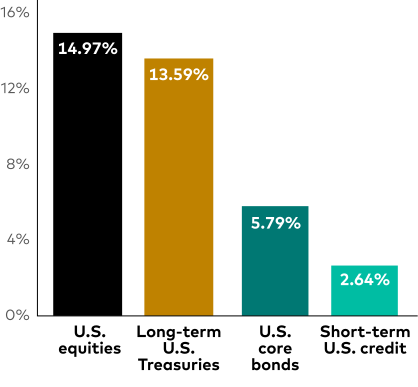
Note: Total risk is estimated on an ex-ante basis using the MSCI Multi-Asset Class Risk Model. Fund holdings and covariance matrix are as of December 31, 2024.
Source: Vanguard calculations, as of December 31, 2024.
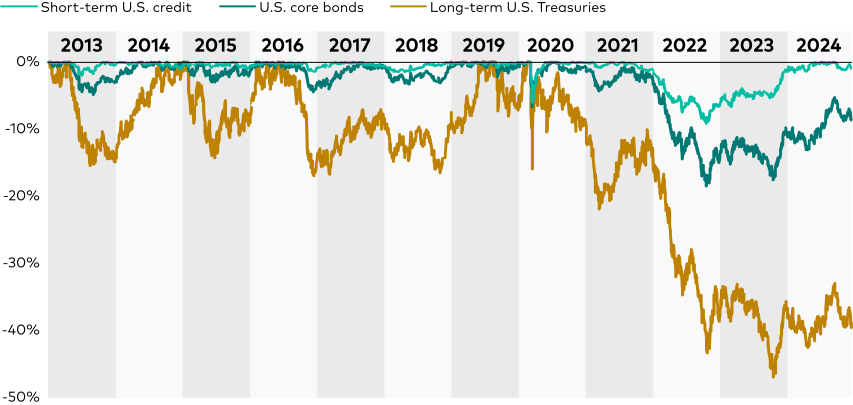
Note: Data spans from the beginning of 2013 through the end of 2024. The indices used are Bloomberg U.S. Aggregate Float Adjusted Index for U.S. core bonds, Bloomberg U.S. Long Treasury Index for long-term U.S. Treasuries, and Bloomberg 1–5 Year Credit Index for short-term U.S. credit.
Source: Vanguard calculations, as of December 31, 2024.
Innovation and evolution within the TDF space
As we continue to deepen our research across asset classes, including fixed income, to evolve our TDF offer, we are also expanding our focus to include innovation and evolution within the TDF space. While we continue to believe that the Target Retirement series is an excellent fit for plans and their participants, we realize that certain plans may also have unique needs and demographics.
For this reason, we are also exploring how additional TDF series could help meet the evolving needs of plans and participants while preserving the core features of the current Target Retirement series. Our current research includes hybrid annuity TDFs, private market exposure, and expanded use of managed accounts that may offer investors a more personalized experience. Expect more on each of these fronts in future publications as we continue to advance our research and evaluate new approaches.
Notes:
- For more information about Vanguard funds, visit vanguard.com to obtain a prospectus or, if available, a summary prospectus. Investment objectives, risks, charges, expenses, and other important information are contained in the prospectus; read and consider it carefully before investing.
- Investments in Target Retirement Funds and Trusts are subject to the risks of their underlying funds. The year in the fund or trust name refers to the approximate year (the target date) when an investor in the fund or trust would retire and leave the workforce. The fund/trust will gradually shift its emphasis from more aggressive investments to more conservative ones based on its target date. The Income Trust/Fund and Income and Growth Trust have fixed investment allocations and are designed for investors who are already retired. An investment in a Target Retirement Fund or Trust is not guaranteed at any time, including on or after the target date.
- Vanguard Target Retirement Trusts are not mutual funds. They are collective trusts available only to tax-qualified plans and their eligible participants. Investment objectives, risks, charges, expenses, and other important information should be considered carefully before investing. The collective trust mandates are managed by Vanguard Fiduciary Trust Company, a wholly owned subsidiary of The Vanguard Group, Inc.
- Vanguard is responsible only for selecting the underlying funds and periodically rebalancing the holdings of target-date investments. The asset allocations Vanguard has selected for the Target Retirement Funds are based on our investment experience and are geared to the average investor. Regularly check the asset mix of the option you choose to ensure it is appropriate for your current situation.
- All investing is subject to risk, including the possible loss of the money you invest. There is no guarantee that any particular asset allocation or mix of funds will meet your investment objectives or provide you with a given level of income. Diversification does not ensure a profit or protect against a loss. Past performance is no guarantee of future results.
- All annuities are subject to risk, including the possible loss of the money you invest. Investments in bonds are subject to interest rate, credit, and inflation risk.
- The Vanguard Life-Cycle Investing Model (VLCM) is designed to identify the product design that represents the best investment solution for a theoretical, representative investor who uses the target-date funds to accumulate wealth for retirement. The VLCM generates an optimal custom glide path for a participant population by assessing the trade-offs between the expected (median) wealth accumulation and the uncertainty about that wealth outcome, for thousands of potential glide paths. The VLCM does this by combining two sets of inputs: the asset class return projections from the VCMM and the average characteristics of the participant population. Along with the optimal custom glide path, the VLCM generates a wide range of portfolio metrics such as a distribution of potential wealth accumulation outcomes, risk and return distributions for the asset allocation, and probability of ruin, such as the odds of participants depleting their wealth by age 95.
- The VLCM inherits the distributional forecasting framework of the VCMM and applies to it the calculation of wealth outcomes from any given portfolio.
- The most impactful drivers of glide-path changes within the VLCM tend to be risk aversion, the presence of a defined benefit plan, retirement age, saving rate, and starting compensation. The VLCM chooses among glide paths by scoring them according to the utility function described and choosing the one with the highest score. The VLCM does not optimize the levels of spending and contribution rates. Rather, the VLCM optimizes the glide path for a given customizable level of spending, growth rate of contributions, and other plan sponsor characteristics.
- A full dynamic stochastic life-cycle model, including optimization of a savings strategy and dynamic spending in retirement is beyond the scope of this framework.
- Advisory services are provided by Vanguard Advisers, Inc. (VAI), a registered investment advisor. Eligibility restrictions may apply.
- Private investments involve a high degree of risk and, therefore, should be undertaken only by prospective investors capable of evaluating and bearing the risks such an investment represents. Investors in private equity generally must meet certain minimum financial qualifications that may make it unsuitable for specific market participants.