1. Insights & Research
  2. DC Retirement
Back
Perspectives : DC Retirement | February 13, 2026

Setting the record straight on advice

  • copyLink Copy Link Link Copied
  • twitter Share with Twitter
  • linkedin Share with Linkedin

Having access to professional advice services to help with selecting investments, setting saving levels, and even managing debt is a boon for retirement plan participants, and right now, advice options are more prevalent than ever.

But still, there are a few misconceptions about advice as a service, what it can do for participants, and whether a plan really needs it. We’ve outlined these myths—and countered them with the realities—in our new paper Advice Myth Busters: Separating Information from Misinformation.

Read our research

Advice can help open doors to better investing

For retirement plan participants, access to advice starts with an advice service offered in their plan. Yet some plan sponsors are resistant to the idea. So let’s take a moment to clear up a few things. 

Participants don’t need investment advice if their plan offers target-date investments.

There’s no question that target-date funds can be a great investment choice. They provide a complete portfolio in a single fund and reallocate to age-appropriate asset mixes over time. But a managed advice service will go one step further by personalizing investment decisions down to an individual level. This means that a participant can receive guidance that not only is relevant to their personal situation but also can help improve their overall financial well-being.

Participants won’t use advice even if it is offered. 

Actually, they probably will. According to How America Saves 2025, the percentage of Vanguard defined contribution plans offering advice services has grown year after year. And as the number of participants with access to advice has increased every year, so has the number of participants who use it. Currently, 9% of all participants use an advice service when offered. That’s because plan sponsors are prioritizing their participants’ financial well-being, and offering advice is a way to do that.

Participants can do it better themselves. 

Maybe some participants can, but certainly not all of them. In fact, participants who use advice are more confident in their retirement strategy than those who don’t.1 And 74% say they would like professional assistance with managing their investments.2 So the desire is there for help in avoiding such missteps as excessive high fees, making poor financial decisions, and diversifying inadequately. And that’s just within a retirement plan. Advice can also help with the broader financial concerns many investors live with day-to-day. 

Advice involves only managing investments.

While participant advice does cover important topics like investments, performance, and fees, studies have shown that it can also touch on key emotional elements beyond portfolio management. In a recent survey, 86% of respondents told us that advice gives them more peace of mind3—which can lead to more confident investment decisions. 

Advice creates fiduciary risk and requires too much oversight.

Perhaps not as much as you might think. As fiduciaries, plan sponsors are bound by the tenets of ERISA, which are to practice prudence and loyalty toward participants. When it comes to advice, plan sponsors are responsible for properly evaluating the service, but their oversight applies only to the selection process and not to the specific advice provided to participants. However, plan sponsors must clearly communicate the costs, risks, and limitations of any advice service to participants.
For a deeper dive into how and why advice can be a prudent option for your retirement plan, read our paper, Advice Myth Busters: Separating Information from Misinformation.

Sources:

1 401(k) Managed Accounts: A Misunderstood Value Proposition. Cerulli Associates, May 2024.

2 Pontera 401(k) Literacy Survey. The Harris Poll, October 2024.

3 Paulo Costa, Marsella Martino, and Malena de la Fuente. The Emotional and Time Value of Advice. Vanguard, 2025. 

Notes:

  • All investing is subject to risk, including the possible loss of the money you invest. There is no guarantee that any particular asset allocation or mix of funds will meet your investment objectives or provide you with a given level of income. Diversification does not ensure a profit or protect against a loss.
  • Investments in target-date funds are subject to the risks of their underlying funds. The year in the fund name refers to the approximate year (the target date) when an investor in the fund would retire and leave the workforce. The fund will gradually shift its emphasis from more aggressive investments to more conservative ones based on its target date. An investment in target-date funds is not guaranteed at any time, including on or after the target date.
  • Advice services are provided by Vanguard Advisers, Inc., a registered investment advisor, or by Vanguard National Trust Company, a federally chartered, limited-purpose trust company.
Related links

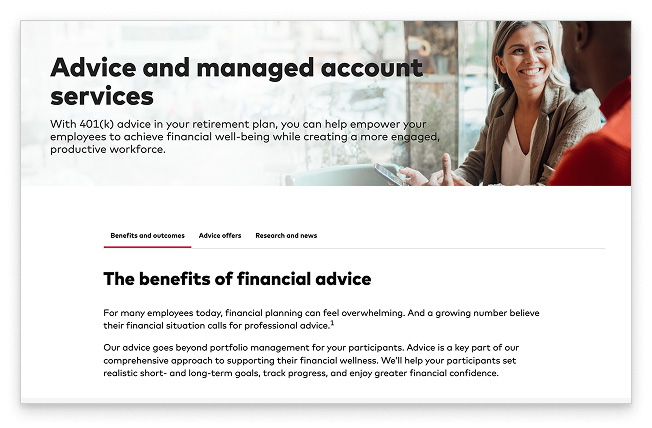
Advice and Managed Account Services
Article Image

  • copyLink Copy Link Link Copied
  • twitter Share with Twitter
  • linkedin Share with Linkedin