


- Origins and role
- Power of indexing
- Wealth generation
- History
Foundations of index fund investing

Share certificate for the first index mutual fund, later renamed Vanguard 500 Index Fund.
3. A few months after the launch of First Index Investment Trust, an article in an investment professionals’ journal opened as follows: “An investor seeking expert opinion on index funds might well be confused by what he hears. One conclusion, usually expressed with considerable feeling, is that index funds are a ‘cop-out’ and a fad that will soon disappear. Apparently only a very small minority hold the opposite point of view. They consider index funds the wave of the future ….”2
4. Jan M. Twardowski first led the portfolio management effort. In 1977, shortly after the First Index Investment Trust launched, a reporter for The New York Times wrote that Mr. Twardowski felt “that the fund’s ‘very low’ total operating costs ... will begin to prove more popular with investors.”3
5. Academic support for the strategy preceded the first index-tracking portfolios for institutional investors and Vanguard’s offering for individual investors. In 1973, one such supporter, Princeton University professor Burton Malkiel, suggested a new investment instrument: “A no-load, minimum-management-fee mutual fund that simply buys the hundreds of stocks making up the market averages and does no trading (of securities) …. Fund spokesmen are quick to point out, ‘You can’t buy the averages.’ It’s about time the public could.”4
6. In his 1951 undergraduate thesis for Princeton University, Mr. Bogle highlighted the crucial role of costs in the long-term returns earned by investors. He identified costs as a drag on the performance of the industry, which was then entirely actively managed.
7. In the years following 1976, Mr. Bogle famously—and often—advised investors...

The important role of index investing
8. Indexing is integral to U.S. retirement savings. As of year-end 2024, 96% of defined-contribution retirement plans offered target-date funds, which rely on indexing as a core building block.5
9. 529 educational savings plans in the United States also rely to a meaningful degree on index funds, according to data from Morningstar.6
10. Index funds can help to enhance market stability in times of market stress. Investors in index-based strategies tend to stay invested during periods of volatility, providing a reliable source of capital.
11. The diversity of index strategies allows investors to move capital across wide swaths of the market, enabling price discovery beyond a narrow group of stocks. That’s because different index funds hold distinct sets of securities, and reallocating assets among them leads to trades that contribute to price formation—even though the index fund investor isn’t making active stock picks.
12. Market data show that volatility and liquidity patterns have remained stable as index investing has grown, indicating that index funds coexist with—and support—well-functioning, dynamic capital markets.7
Indexing is an easily explained investment strategy
13. When John C. Bogle launched Vanguard 500 Index Fund on August 31, 1976, as First Index Investment Trust, he gave individual investors access to a strategy previously available only to institutional investors. The first index fund for individual investors embodied the Vanguard founder’s belief that most investors are better served by owning the whole stock market, at low cost, rather than trying to beat it.
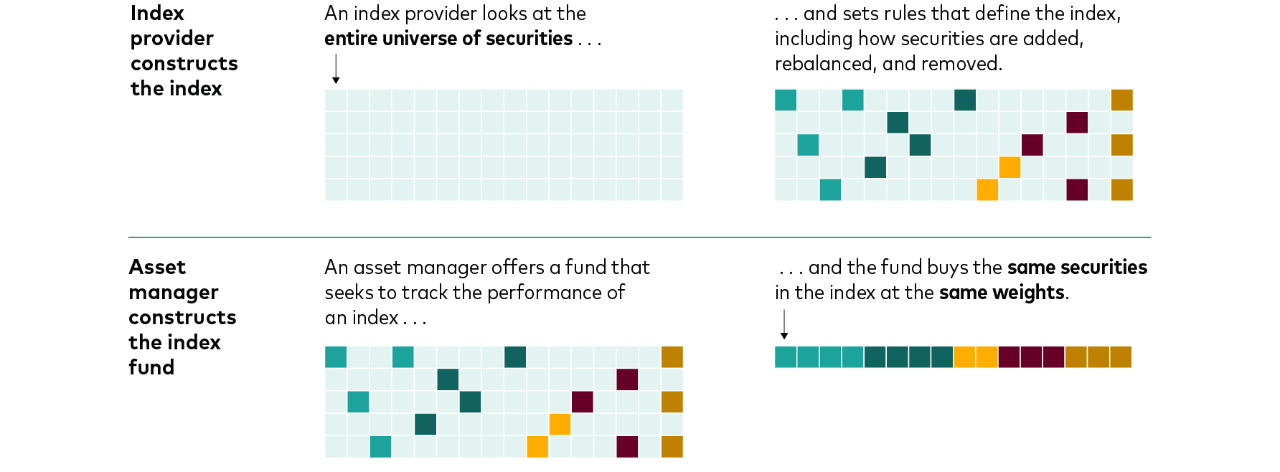
14. Index funds hold the same securities as their benchmarks (or representative samples of them), target the indexes’ weights, and rebalance their holdings when the indexes do. Their rules-based design reinforces investor trust by making outcomes relatively predictable, even though the absolute returns of markets are not.
Financial market indexes are rules-based benchmarks
Source: Vanguard
15. Indexing is an unbiased approach to tracking a market or market segment. If a public company represents 2% of the market before an index fund investment, it represents 2% of the market after an index fund investment. Individual stocks and bonds grow larger or smaller because of the aggregate decisions of active portfolio managers.
Indexing offers built-in diversification and empowers investors to customize portfolios
16. Vanguard 500 Index Fund provides diversification across roughly 500 leading U.S. companies, representing about a dozen economic sectors, two dozen industry groups, 75 industries, and roughly 160 subindustries. The number of companies in the benchmark often varies slightly from 500, owing to such issues as companies issuing multiple share classes, mergers and acquisitions, and spin-offs.8
17. From an initial focus on a single benchmark, the S&P 500 Index, equity index fund investing has transformed into a vibrant ecosystem of more than 6,700 benchmarks globally and an even larger number of funds that compete to track those indexes as closely as possible.
Financial market indexes are rules-based benchmarks

Note: Data as of December 31, 2024.
Source: Morningstar, Inc.
18. Index fund investors aren’t as “passive” as they seem. Collectively, their portfolios do not mirror the broad financial markets—for example, their exposures to various economic sectors and countries tend to differ from those implied by market capitalizations. Instead, investors employ index funds to build actively oriented portfolios while taking advantage of the benefits of index investing.9
19. Even active managers use index funds to hedge risk or adjust market exposure without having to sell individual securities. Many managers invest a portion of their portfolio in index funds to serve as a stable, low-cost “core” while dynamically managing “satellite” positions to try to outperform the market. Active managers also use exchange-traded index funds to temporarily hold cash so they can stay invested in the market while deciding where to allocate funds.
20. Vanguard uses a multidimensional process to evaluate and select benchmarks for index funds and ETFs. To support the myriad needs of investors around the world, we license a variety of equity indexes from such sponsors as CRSP, FTSE Russell, S&P Dow Jones Indices, FTSE/BIVA, and MSCI, as well as a multitude of fixed income indexes from Bloomberg.
Investment costs matter—and indexing is a low-cost approach
21. With minimal overhead and trading, index funds cost less to manage than actively managed funds, which means more of their returns stays where they belong—with investors. As of year-end 2024, the average expense ratios of index and active funds—that is, their annual operating expenses as a share of their average net assets—were 0.11% and 0.59%, respectively.10
22. Index funds like Vanguard 500 Index Fund helped drive The Vanguard Effect®, spurring competitors to lower fees and reducing costs across the investment industry, even for non-Vanguard investors.
23. Over one recently ended 25-year period, indexing helped investors save an estimated $503 billion in fees—money that stayed invested and continued compounding.
Index fund investors’ estimated cumulative cost savings since 2000

Note: Data are as of December 31, 2024, for U.S.-domiciled mutual funds and ETFs, based on net expense ratios. In this hypothetical example, we assume that if index funds had not existed, would-be index investors would have invested in active funds charging the then-prevailing, asset-weighted average active fund expense ratio. Data reflect the difference between the cumulative expense ratio fees paid by investors owning open-end funds and what they would have paid if index funds didn’t exist. Investor savings are calculated as: (asset-weighted expense ratio of actively managed funds multiplied by industry assets) minus (asset-weighted expense ratio of index funds multiplied by industry assets).
Source: Vanguard calculations, based on data from Morningstar, Inc.
24. It is far cheaper for an investor to buy shares in an index fund than to replicate the index themselves. Directly buying at least one share of each stock in the S&P 500 Index and maintaining the resulting portfolio to reflect the stocks’ market capitalizations would cost around $3.2 million.11
25. Historically, longer investment holding periods have helped index funds to minimize their transaction costs and long-term index fund investors to keep more of the financial markets’ returns.
26. Because they generally trade less often than actively managed funds, index funds also tend to make smaller capital gains distributions. That means indexing can help to minimize the erosion of gains due to levies on taxable accounts—a subtle cost that investors may not always recognize.12
Index funds' consistent relative performance powers their wealth-generating potential
27. Index funds are designed to deliver relatively consistent performance by mirroring their benchmarks, not trying to beat them. That reliability gives investors a powerful foundation for disciplined asset allocation.13
28. Lower fees and longer time horizons can dramatically increase the impact of compounding over a lifetime, which is why indexing has proven especially powerful for younger investors.
Higher costs significantly depress a portfolio’s growth

Source: Vanguard.
29. On average, 20%–25% of U.S. mutual funds disappear during any given five-year period. Over multidecade horizons, cumulative closures reach into the tens of thousands. Thus, long-running funds especially those dating back to the 1970s are extreme outliers, not the norm. For 50 years, Vanguard 500 Index Fund has served as an investible version of the S&P 500 Index, quietly outliving countless next-big-thing strategies that failed to endure.14
30. Vanguard 500 Index Fund has persisted through every major market event of the last 50 years, including inflation shocks, banking crises and recessions, and market bubbles, corrections, and crashes. As of February 28, 2026, Investor Shares in Vanguard S&P 500 Index Fund (VFINX) had an average annual total return since inception of 11.58%, closely tracking its benchmark.15
31. Admiral Shares of Vanguard 500 Index Fund have maintained a Morningstar Medalist Rating of Gold since the industry researcher's rating system began in 2011, a rare achievement.16
32. What if, at the fund's inception in 1976, you'd put $10,000 into what are now called Investor Shares of Vanguard 500 Index Fund? The investment could have grown to nearly $2.2 million by February 28, 2026, illustrating the powers of discipline, low-cost investing, and compounding.17
Index funds can help investors build wealth

Note: The portfolio balances shown are hypothetical and do not reflect any particular investment. In this example, the accounts return 6% annually, then investment costs are taken at the end of the year. The rate of return is not guaranteed. The final account balances do not reflect any taxes or penalties that might be due upon distribution. Costs are one factor that can impact returns. There may be differences between products that must be considered prior to investing.
Past performance is no guarantee of future results.
Source: Vanguard calculations, using data from Morningstar, Inc.
Vanguard 500 Index Fund through the years

34. Michael Buek was the longest-serving portfolio manager, steering Vanguard 500 Index Fund for 25 years.
35. Vanguard index funds are supported by centralized teams, which evolve through deliberate and overlapping manager transitions. Vanguard 500 Index Fund has had only eight lead portfolio managers in 50 years.
36. Vanguard 500 Index Fund offers three conventional fund share classes to suit different types of investors—Investor Shares (VFINX), Admiral Shares (VFIAX), and Institutional Select Shares (VFFSX). It also offers ETF Shares (VOO), which trade throughout the day like individual stocks. The share classes otherwise differ in their minimum initial investments and expense ratios.18
37. In 2025, investors made $137.7 billion in new net investments in ETF Shares of Vanguard 500 Index Fund (VOO), a record-breaking inflow for an ETF, according to ETF.com.19
38. Initially, the annual operating expenses of Vanguard 500 Index Fund, expressed as a share of its average net assets, amounted to 0.43%. Today, the fund’s largest share classes, which account for nearly all its assets, charge roughly one-tenth as much: 0.03% for ETF Shares and 0.04% for Admiral Shares.
39. Because Vanguard 500 Index Fund holds a broadly diversified collection of large-cap stocks, investors may consider it a core, long-term equity holding.
40. Vanguard 500 Index Fund is a part of Vanguard’s Investor Choice program, which enables everyday investors, their advisors, 529 plans, and retirement plan sponsors to participate easily in the corporate proxy voting process.
About Investor Choice

Source: Vanguard, as of December 31, 2025 (eligible equity index fund AUM); as of September 10, 2025 (participating equity index fund AUM and participating fund shareholders).
41. Vanguard offers funds tracking the S&P 500 Index to investors in Canada, Mexico, Europe, and Australia. A trio of Australian funds were just launched on March 4, 2026, giving investors there “a straightforward, low-cost entry point to the world’s largest economy,” according to Duncan Burns, Asia‑Pacific head of Investment Management for Vanguard Capital Markets.
History of indexing
42. With the adoption in 1977 of a no-load approach to distribution, which bypassed traditional broker-dealer sales charges, Vanguard helped ensure lower costs and greater returns for its index fund investors.
43. In 1986, Vanguard launched the industry’s first bond index fund, now known as Vanguard Total Bond Market Index Fund.
44. The Federal Employees’ Retirement System Act of 1986 established the Thrift Savings Plan for federal government employees and uniformed service members as an index-based plan. Most of the $1 trillion plan’s core offerings are index funds and target-date funds of funds that invest primarily in index funds.20
45. Now a cornerstone of the mutual fund industry, indexing led in the early 1990s to another investment innovation—the exchange-traded fund (ETF).
46. 2000, the first American to win the Nobel prize in economics, Paul Samuelson, described the creation of index funds as ...21
. . . the equivalent of the invention of the wheel and the alphabet.

Former Vanguard Chief Investment Officer Gus Sauter.
48. Owning the market beats trying to beat the market.” —John C. Bogle, The Little Book of Common Sense Investing (Wiley, 2007)
49. To many Americans, indexing probably seems a longstanding investment approach. Roughly two-thirds of them were born after Mr. Bogle introduced the first index fund for individual investors.22
50. In light of the long history of investing—people began to trade bond-like instruments thousands of years ago, stocks more than 400 years ago, and mutual funds more than 100 years ago—the index fund remains relatively young at 50 years of age.
Indexing: 50 years young

Sources:
1. Vanguard’s founder recounted the initial fundraising for First Index Investment Trust—and indexing’s rise over the next 35 years—in a September 2011 guest column for The Wall Street Journal. (Subscription required.)
2. Walter R. Good, Robert Ferguson, and Jack Treynor. An Investor’s Guide to the Index Fund Controversy. Financial Analysts Journal, 1976, 32(6): 27–36. Introduction available at: https://www.tandfonline.com/doi/abs/10.2469/faj.v32.n6.27.
3. Phalon, Richard. Beating the Market or “Indexing” It? The New York Times, 1977. https://www.nytimes.com/1977/03/26/archives/personal-investing-beating-the-market-or-indexing-it.html.
4. This quote is from a 1997 Vanguard publication, The First Index Mutual Fund: A History of Vanguard Index Trust and the Vanguard Index Strategy. Vanguard founder John C. Bogle cites Mr. Malkiel’s call for an index fund in the latter’s 1973 book, A Random Walk Down Wall Street (W.W. Norton). Note that, for about the first six months of its existence, First Index Investment Trust was sold via brokers, and shareholders had to pay sales loads or commissions to purchase shares. All Vanguard funds adopted a no-load distribution strategy in early 1977. Also in 1977, Mr. Malkiel joined the boards of directors of the Vanguard funds.
5. Our source is the Vanguard report How America Saves 2025, available at https://workplace.vanguard.com/content/dam/inst/iig-transformation/insights/pdf/2025/has/2025_How_America_Saves.pdf.
6. Source: Morningstar research report, 2025 529 Savings Plan Landscape, August 2025. See, in particular, page 6.
7. James J. Rowley, Jr., Stephen Lawrence, and Ollie Ryder-Green. Setting the Record Straight: The Truths About Index Fund Investing. Vanguard, 2025.
8. Approximate sector and industry counts reflect Global Industry Classification Standards.
9. For an illustration of the construction of actively oriented portfolios by index fund investors, see Figure 4 in the Vanguard publication Setting the Record Straight: The Truths About Index Fund Investing. See also the Vanguard article Beyond Beta: Charting the Evolution of Index Investing (Rowley, Jr., and Ryder-Green, February 2026), available at https://corporate.vanguard.com/cont ent/corporatesite/us/en/corp/articles/beyond-beta-charting-evolution-index-investing.html.
10. Expense ratios are asset-weighted averages, reflecting U.S.-domiciled mutual funds and ETFs, as reported in the Morningstar 2024 U.S. Fund Fee Study. See Fund Fees Are Still Declining, But Not as Quickly as They Once Were (Zacharay Evens, May 2025), available at https://www.morningstar.com/financial-advisors/fund-fees-are-still-declining-not-quickly-they-once-were.
11. Source: Vanguard calculations, based on data from Bloomberg, as of November 30, 2025.
12. For an illustration of the relationship between fund turnover and after-tax performance, see Figure 6 in the Vanguard research paper Considerations for Index Fund Investing (Lawrence, Patterson, and Ertl, 2024), available at https://corporate.vanguard.com/content/dam/corp/research/pdf/considerations_for_index_fund_investing.pdf.
13. For an illustration of the relative performance predictability of index funds, see Figure 2 in the Vanguard research paper Considerations for Index Fund Investing.
14. Roughly 5% of U.S. mutual funds disappear each year through mergers and liquidations. Sources: Vanguard calculations, based on data from the CRSP Survivor-Bias Free US Mutual Fund Database.
15. The annualized return of VFINX from inception through February 28, 2026, trailed the 11.83% return of the S&P 500 Index by 0.25 percentage point. Standardized performance for periods ended December 31, 2025: 1 year, VFINX 17.71%, S&P 500 Index 17.88%; 5 years, VFINX 14.26%, S&P 500 Index 14.42%; and 10 years, VFINX 14.66%, S&P 500 Index 14.82%. The current VFINX expense ratio is 0.14%. Sources: Vanguard and Morningstar Direct.
The performance data shown represent past performance, which is not a guarantee of future results. Investment returns and principal value will fluctuate, so that investors' shares, when sold, may be worth more or less than their original cost. Current performance may be lower or higher than the performance data cited. For performance data current to the most recent month-end, visit our website at https://workplace.vanguard.com/investments/product-details/fund/0040.
16. Source: Morningstar Direct. For the company’s medalist rating methodology, refer to the notes section below. See also Morningstar’s current assessment of the fund; available at: https://www.morningstar.com/funds/xnas/vfiax/analysis.
17. Vanguard 500 Index Fund no longer offers Investor Shares (ticker: VFINX) the original share class, first offered in 1976 to new investors. Following are the fund s three other share classes, their inception dates, and minimum initial investments: Admiral (VFIAX), November 13, 2000, $3,000; ETF (VOO), September 7, 2010, the cost of a single share (less at brokerage firms that support fractional share purchases); and Institutional Select (VFFSX), June 24, 2016, $5 billion. Source: Vanguard.
18. Investor Shares in Vanguard 500 Index Fund are closed to new investors.
19. Sumit Roy. U.S. ETFs Pull In a Record $1.49 Trillion in 2025. etf.com, January 2026. https:// www.etf.com/sections/monthly etf flows/us etfs-pull record-149-trillion-2025.
20. 2024 Annual Report of the Thrift Savings Plan. Federal Retirement Thrift Investment Board, 2025. https://www.frtib.gov/pdf/reading room/congress/annual/TSP Annual Report_2024.pdf.
21. Jonathan Burton. Investment Titans: Investment Insights from the Minds That Move Wall Street. McGraw-Hill, 2000.
22. Vanguard calculations, based on data from the U.S. Census Bureau’s Population Division, Annual Estimates of the Resident Population by Single Year of Age and Sex for the United States: April 1, 2020, to July 1, 2024, released June 2025.
Notes:
For more information about Vanguard funds, visit vanguard.com to obtain a prospectus or, if available, a summary prospectus. Investment objectives, risks, charges, expenses, and other important information are contained in the prospectus; read and consider it carefully before investing.
Vanguard ETF Shares are not redeemable with the issuing Fund other than in very large aggregations worth millions of dollars. Instead, investors must buy and sell Vanguard ETF Shares in the secondary market and hold those shares in a brokerage account. In doing so, the investor may incur brokerage commissions and may pay more than net asset value when buying and receive less than net asset value when selling.
All investing is subject to risk, including the possible loss of the money you invest.
Be aware that fluctuations in the financial markets and other factors may cause declines in the value of your account. There is no guarantee that any particular asset allocation or mix of funds will meet your investment objectives or provide you with a given level of income.
Diversification does not ensure a profit or protect against a loss.
Past performance is no guarantee of future returns. The performance of an index is not an exact representation of any particular investment, as you cannot invest directly in an index.
Investments in bonds are subject to interest rate, credit, and inflation risk.
The Morningstar Medalist Rating is not a credit or risk rating. The Medalist Rating is a forward-looking, qualitative assessment of a strategy’s merits. It takes the form of Gold, Silver, Bronze, Neutral, and Negative. The highest ratings go to strategies expected to outperform their Morningstar Category Index over a market cycle. Meanwhile, Neutral- and Negative-rated strategies are expected to lag their category index over time. The ratings are composed of three “pillars”: People, Process, and Parent. The People pillar summarizes Morningstar’s view of the team managing the strategy and the quality of the underlying recommended funds. The Process pillar summarizes Morningstar’s view of the portfolio construction, risk management, and any tactical allocation process. The Parent pillar measures the quality of the strategy’s advisor and board of directors, taking in consideration an alignment of interests between investors and the people who control the destiny of a strategy. For details about these ratings, including their methodology, please visit morningstar.com/investing-definitions/morningstar-medalist-rating-for-funds.
© 2026 Morningstar, Inc. All Rights Reserved. The information contained herein: (1) is proprietary to Morningstar and/or its content providers; (2) may not be copied or distributed; and (3) is not warranted to be accurate, complete or timely. Neither Morningstar nor its content providers are responsible for any damages or losses arising from any use of this information.
CFA® is a registered trademark owned by CFA Institute.
S&P® and S&P 500® are registered trademarks of Standard & Poor’s Financial Services LLC (“S&P”) and have been licensed for use by S&P Dow Jones Indices LLC and its affiliates and sublicensed for certain purposes by Vanguard. The S&P Index is a product of S&P Dow Jones Indices LLC and has been licensed for use by Vanguard. The Vanguard Fund(s) is not sponsored, endorsed, sold, or promoted by S&P Dow Jones Indices LLC, Dow Jones, S&P or their respective affiliates, and none of S&P Dow Jones Indices LLC, Dow Jones, S&P nor their respective affiliates makes any representation regarding the advisability of investing in such product(s).